Thailand BOI Case: Chinese Home Appliance Maker Moves from an Unclear Category to Approval for Circuit Board Assemblies
— From an unclear category to approval as circuit board assemblies: how Z&X reworked the project definition and capital plan
1. Summary: Identifying the promoted manufacturing activity is what makes fitting incentives attainable
A Chinese export-oriented home appliance company setting up a factory in Thailand first prepared its filing around three end appliances, which risked not matching the promotion list or falling into category 4.2.20, which carries no corporate income tax exemption. After submission, the officer still could not determine the project category. Z&X traced the in-house circuit board processes and redefined the project as producing circuit board assemblies on a complete surface-mount line together with downstream products under the same project, while recalibrating the investment and capital plan. Submitted on April 28, 2025, the project was approved under category 4.2.5.2 on September 29 with a 3-year corporate income tax exemption, and the certificate was received on December 12. Z&X's key value was turning real manufacturing capability into a filing that could be recognised and carried out.
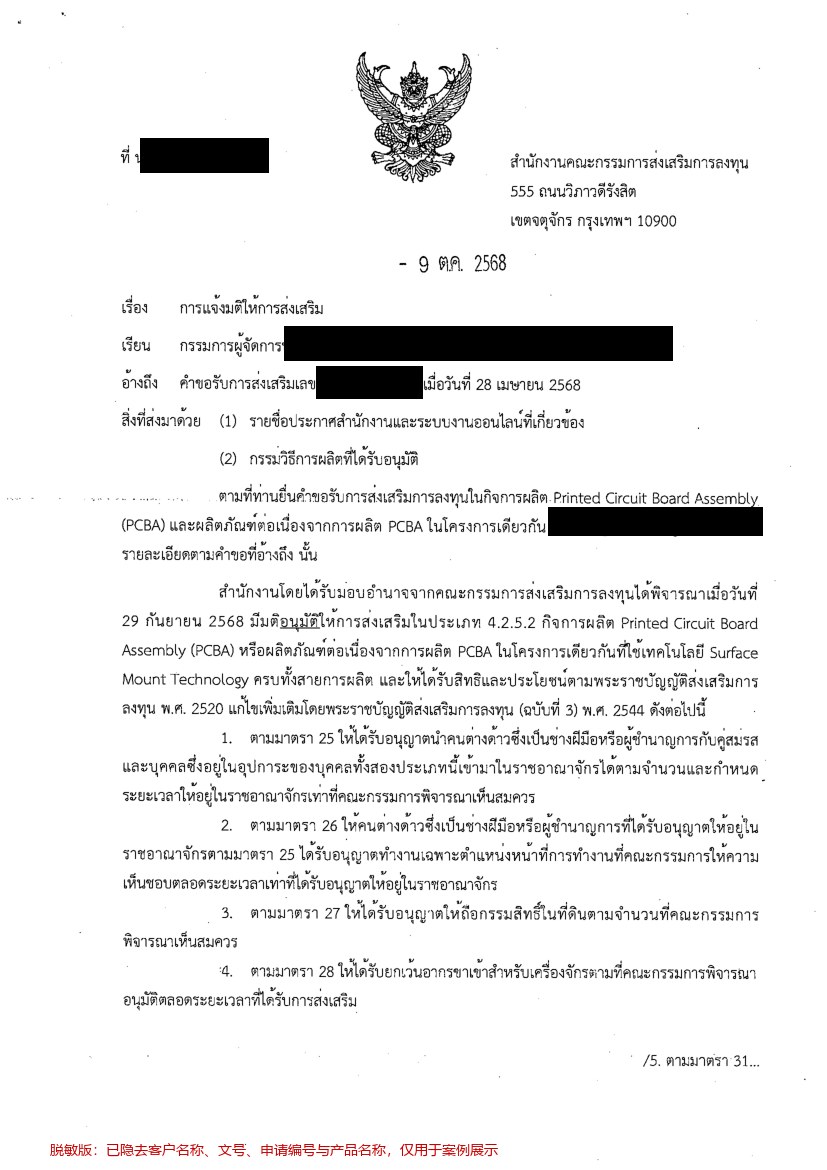
BOI approval letter, Thai original, first page (redacted)
2. Background: An export factory needed to turn its product plans into a basis for approval
The Chinese client leased a factory in eastern Thailand to build an export base; its Thai company was incorporated on December 23, 2024, and its products are aimed at the US market. The circuit boards it planned to produce handle temperature control, timing and protection, and are key components for running the end appliances. From February 2025, the client submitted product, equipment, investment and production plans in stages. Z&X took on BOI pre-review, the category argument, additional documents and certificate collection; this case was exempt from the project presentation, so the written materials became the main means of explaining the project.
3. Problem analysis: The category question exposed a gap between the project definition and the funding basis
The client described its factory by consumer-market product names, while the officer needed to judge which promoted manufacturing activity would take place in Thailand. Looking only at the three appliances, the project could easily be read as final assembly; stressing only the importance of the circuit boards was not enough to prove that the boards were made in the factory itself. The real gap was the lack of a verifiable link between end-product functions, in-house circuit boards, the production line and the conditions of the promotion list. The officer asked for separate explanations of uses and working principles; the real aim was to find a factual basis for determining the project.
So the officer's category question was not a request for the company to rewrite its product introduction. Adding only consumer uses might still prove three appliances; stressing only the control boards could not answer how the boards relate to the finished appliances. Z&X had to explain eligibility conditions, production boundaries and equipment investment together, so that the additional documents moved from adding information to removing doubts about the determination.
Funding arrangements were another constraint. The estimated investment clearly did not match the original registered capital, so share capital, debt and sources of funds had to be verified. The BOI requires a debt-to-equity ratio of no more than 3:1 for new projects, and total investment divided by registered capital cannot be treated directly as that ratio. A feasible category does not mean a feasible funding structure; a capital increase plan that can be explained does not mean the funds and proof are in place.〔2〕
Errors in the materials amplified both doubts: the production plan did not match maximum capacity, raw materials were listed only by internal codes, and figures in units of 10,000 yuan were entered in a column for millions of baht, all of which prevented the review from recalculating the investment and profit forecasts. The client's engineers knew production and its finance staff knew funding, but they did not necessarily understand the boundaries of the promotion list or the dependencies within the filing. If the service stopped at translating and forwarding, the burden of judgment would remain inside the client; Z&X needed to identify which facts could change the category and which figures had to be rechecked together.
4. Method and strategy: Redefining the project required rebuilding both the evidence and the capital logic
Z&X moved the question from "what these appliances are called" to "what manufacturing the factory completes". Category 4.2.5.2 covers printed circuit board assemblies (PCBA) produced on a complete surface-mount technology line, together with downstream products under the same project. Pursuing this route required proving in-house production and the complete-line condition, and explaining how the circuit boards go into the project's end products; having circuit boards, buying one placement machine or changing product names cannot replace the eligibility argument.〔1〕
The strategy was therefore split into two mutually constraining judgments: first verify whether the real processes could support the PCBA route, then check equipment, raw materials, capacity and investment against that scope. Boards used internally in finished appliances and boards sold externally also had to be separated, to avoid output, costs and income being double-counted or disconnected. Redefining the project changed the manufacturing activity the review recognised, not the facts of what the company actually produces.
The capital plan likewise followed production needs. Increasing share capital means shareholders commit more funds; cutting investment must correspond to equipment and project scale that can genuinely be reduced. Z&X proposed two options so the client could weigh its funding capacity against production line needs, avoiding shrinking investment figures just to meet the ratio, or deciding on a capital increase first and then finding the necessary investment still not covered.
The two options made explicit what management had to decide: what production scale to keep, how much real share capital to support it with, and when to complete the transfer of funds. The adviser explains conditions and trade-offs, the client makes business decisions and puts the funds in place, and the authority makes its determination on the evidence; only then can the capital adjustment and production plans be carried out together.
Z&X's own CODE compliance-growth model was applied in this case as follows: O (Orchestrated Structure) linked category, production and capital; D (Dual-Track China–Thailand Coordination) had Qing Su, the team's Thailand-side head, prepare a Chinese–Thai review checklist, the client's engineering and finance staff confirm the facts, and Z&X consolidate the formal replies; E (Verifiable Delivery) kept annotations, revised drafts and working papers; and C (Compliance Calendar) connected the review, capital increase, capital injection proof and certificate milestones. Its distinguishing feature was organising rule judgment, technical verification and client decisions into one continuous piece of work.
5. Plan and implementation: Page-by-page pre-review carried the new route into a complete application
Before submission, Z&X pre-reviewed the application page by page on February 19–20 and produced a 7-page list of issues, asking whether the circuit boards were made in-house or purchased, and checking product uses, the lease, equipment, raw materials and profit forecasts. The client revised in three rounds, on February 26, March 5 and March 14. The value of the pre-review was exposing conflicts between pieces of information early, so that engineering and finance answered questions around the same project.
After submission, facing the officer's category question, Z&X added the uses and working principles of the three products and the control functions of the circuit boards, and explained that some boards are sold to outside manufacturers of similar products; it broke the process down into solder paste printing, placement, reflow soldering, automated optical inspection, through-hole insertion and wave soldering, and organised the product, process, equipment and raw material documents. The function explanation answered why the boards are key, the processes and equipment answered how they are made in Thailand, and the same-project relationship answered why the end products belong in this route.
The data were recalculated at the same time. Z&X asked for raw materials to be given recognisable generic names, equipment, unit prices and costs to be split by product, the currency and units of the income statement to be corrected, and planned output to be checked against this case's three-year ramp-up of 50%, 70% and 100%. The aim was to make the production plan, sales forecast and maximum capacity explain one another; this ramp-up ratio was a calculation arrangement for this case and should not be presented as a uniform requirement for all BOI projects.
On capital, Z&X proposed two options, increasing share capital or genuinely reducing investment; the client re-determined investment based on equipment needs and chose the capital increase. The option meeting the conditions was settled during the review, and after approval the capital increase was completed in November and certificate issuance moved forward. The certificate team then pointed out that proof of foreign capital injection was insufficient; Z&X continued to organise the missing documents, distinguishing registered capital, paid-up arrangements and verifiable injection records, and finally connected this to certificate collection.
| Key milestone | Recorded result |
|---|
| February–March 2025 | Page-by-page pre-review; three rounds of revisions against the checklist. |
| April 28 and after submission | Application submitted; category argument, data corrections and capital plan organised. |
| September 29 – October 9 | Approved, followed by the approval letter. |
| November – December 12 | Capital increase and injection documents checked; investment promotion certificate obtained. |
6. Results and value: The incentives came from manufacturing facts and funding conditions both holding up
The project was finally approved under category 4.2.5.2 with a 3-year corporate income tax exemption, capped at the investment amount recognised in the approval conditions (excluding land and working capital), together with applicable rights such as import duty exemption on machinery and on raw materials for export. Approval came about 5 months after submission, and the certificate about 7.5 months after. Compared with the exemption gap of the original route, the new plan gained recognition matching the real PCBA manufacturing capability, while taking the capital plan through to the documents needed for the certificate.
The verifiable results of this case are the approval and the certificate; the value lies in a clear promotion scope, the tax exemption, and a continuous record for later investment and compliance.
7. Conclusion: The strength of BOI services lies in organising manufacturing facts into workable judgments
The lesson for the industry is that filing quality depends on how the project is defined, proven and carried out. A company's product language, engineering language and funding language must together explain the same promoted activity. Service providers should be able to find the real capability hidden behind end-product names, compare lawful routes, explain the funding cost of the choice, and keep later documents on the same factual basis.
This requires BOI services to move from filling in individual forms to cross-disciplinary judgment and evidence organisation. What can be reused is the method of identifying conditions, verifying facts and linking decisions, not the conclusion that "having circuit boards means a tax exemption". Only when manufacturing conditions, capital arrangements and execution evidence all hold up can a policy opportunity become a lasting operating foundation for the company.
Chinese companies preparing to set up an electronics or electrical appliance factory in Thailand can submit product uses, in-house and outsourced processes, an equipment list, and investment and funding source plans to request a BOI eligibility and category assessment from Z&X.
Related: Thailand BOI Investment Promotion Application; Company Registration & Approval Services for Chinese Manufacturers in Thailand; Company Registration & Approval Services for Chinese Electronics and Semiconductor Manufacturers in Thailand
Public references
〔1〕BOI Announcement 9/2565: category 4.2.5.2 and production line conditions
〔2〕BOI Announcement 8/2565, item 5.3.2: capital conditions for new projects
This case was filed in 2025; the rules applied and the incentives are to be verified against the announcements in effect at the time of application, the project approval and the certificate.



 One on one exclusive financial and tax consultation