Thailand BOI Case: Feed Group Recalculates Capacity by Equipment Specifications and Replies the Same Day
— From questions on the capacity method to a same-day recalculation: how Z&X used equipment evidence to keep the review window and carry the project through to the certificate
1. Summary: An effective same-day reply depends on accurate judgment and connected evidence
A large Chinese feed group setting up a new factory in Thailand applied for four product types: fish feed, shrimp feed, poultry feed and pig feed. On December 17, 2025, the officer of the Board of Investment (BOI) asked the company to delete its self-defined capacity factor and recalculate by equipment specifications; only a same-day reply could make that month's review. Z&X coordinated with the client's engineers to confirm the hourly output of the equipment, recalculated, revised the application pages and returned everything with the manuals that same day. The project was approved on the 19th of the following month, about 4.5 months after acceptance, and after an address change the certificate was issued on May 14, 2026. The key to this case was turning production data familiar to the company into a basis the review could verify, and completing an effective reply within limited time.
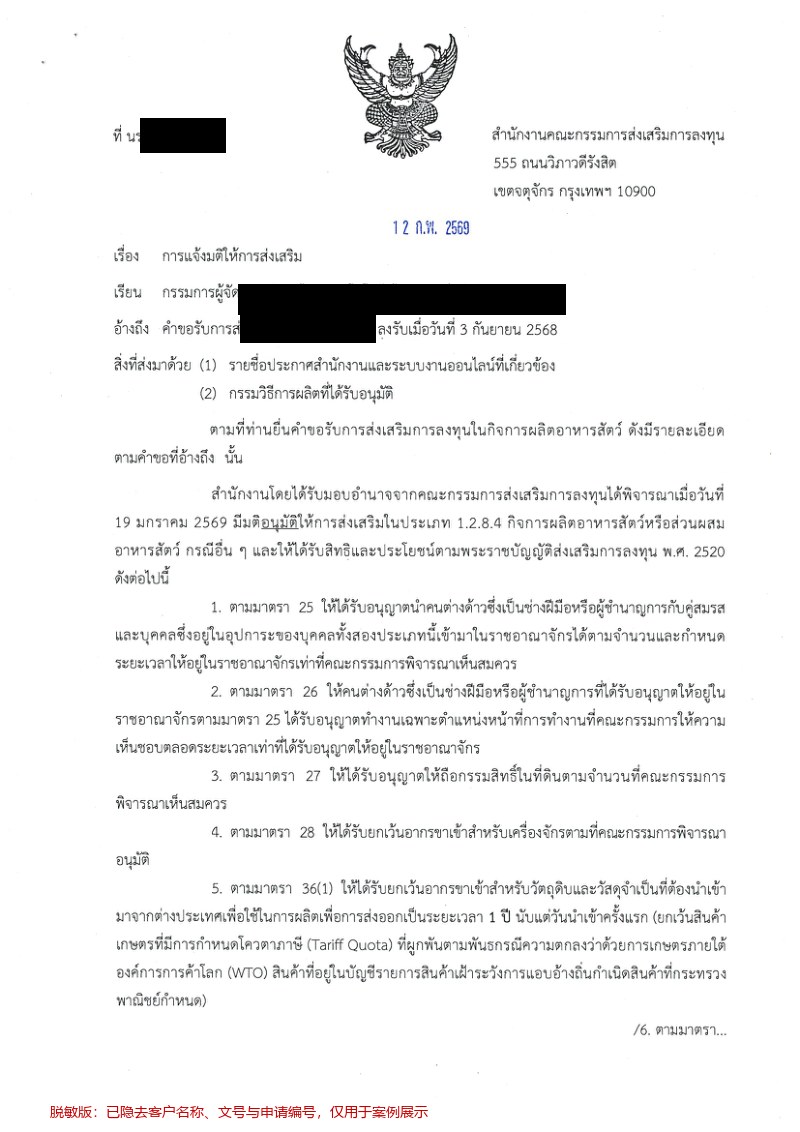
BOI approval letter, Thai original, first page (redacted)
2. Background: Four product types each needed their own basis within one application
The client set up its Thai company through the group's Southeast Asian investment platform to build a compound feed factory serving the Thai market. The four production lines share feeding, grinding and batching-mixing equipment at the front end, while pelleting or extrusion, cooling, grading and packing run separately at the back end. Because products and main equipment specifications differ, a general total factory capacity cannot replace the calculation for each product.
Z&X handled pre-review, the project presentation, replies to additional document requests, and the post-approval address change and certificate. The application was accepted on September 3, 2025. What the client needed was for investment and production plans to match the approval conditions, providing a workable basis for later construction and equipment imports.
3. Problem analysis: The second round of questions required a capacity method verifiable by equipment
After the presentation on September 30, the BOI officer asked the company to check funding, product breakdown, working hours, main equipment, raw materials and expenses. The presentation materials and the application form were not consistent, and the figures from different departments had not yet formed a complete explanation. By December 17, the questions narrowed further: how much each main machine produces per hour, why the four products have different hourly outputs, and whether the factor came from specifications or the company's own estimate. The two rounds pointed to different levels: once the tables were consistent, the parameters themselves still needed a basis.
The written questions show that the officer wanted to verify the full-load capacity supported by the equipment. The BOI application form also clearly requires calculation based on the maximum capacity of the main equipment and working time.〔1〕A company's internal experience factor can serve production planning, but if its source, applicable conditions and role in the calculation cannot be explained, the review cannot recalculate from it. Full-load capacity must also be kept separate from expected sales and actual utilisation; one factor should not be made to explain all of these at once. What was deleted in this case was a self-defined factor lacking a specification basis; it does not follow that no project may use a well-founded adjustment parameter.
The client's engineers know the equipment and its finance staff know the investment and forecasts, but they may not be able to decide within one day which parameters need new evidence and which application pages must change together. If a service stops at translating and forwarding "please recalculate", the client still has to make that judgment alone. Z&X's difference was understanding the purpose of the question and breaking the task down to specific products, models and manuals, so that technical facts directly served the matter under review.
4. Method and strategy: Defining the scope of changes first makes replies efficient
Z&X first separated inconsistent information from an insufficient calculation basis. The former had to be brought back to one version of the real data; the latter required an updated calculation, and old figures could not be kept just because "the application form had already been submitted". Confirming 20 working hours a day earlier avoided changing operating plans without basis; recalculating capacity after the new request made the filing follow verified equipment facts. Both rounds followed the same standard: keep the parameters that have a basis and correct those that cannot stand.
The case was carried out with Z&X's own CODE compliance-growth model: O (Orchestrated Structure) connected products, equipment, capacity and related forecasts; D (Dual-Track China–Thailand Coordination) organised engineers to provide the technical basis, while Z&X's Thailand-side head dealt with the review and prepared the replies; E (Verifiable Delivery) kept the trilingual replies, per-product calculations and manuals; and C (Compliance Calendar) tracked additional documents, the review and post-approval matters. The professional threshold of this division of work is that the adviser knows whom to ask for what, and the client knows which facts it must confirm itself.
The same-day window also required control over the scope of changes. Questions about equipment specifications had to be checked with the engineers directly rather than guessed during translation; once capacity changed, the production plan, raw materials and expenses had to be checked for knock-on effects. Response speed was supported by this judgment and handover ability; pushing alone does not reduce rework.
5. Plan and implementation: Recalculating capacity by specification and connecting later procedures
The first set of additional documents clarified the whole project. The system had only three product rows, so Z&X attached separate capacity figures and production plans for the four product types, explained the process relationship of shared front-end and independent back-end lines, and checked the funding plan, raw material sources, expense structure and the reasons for first-year losses. The team returned a Chinese, Thai and English reply on October 14.
The second set dealt directly with the calculation basis. On December 17, Z&X coordinated with the engineers to provide the equipment models and standard hourly outputs for the four products: ring-die pellet mills for shrimp, poultry and pig feed, and a twin-screw extruder for fish feed. The specifications of the different models explained the differences in hourly output and avoided forcing four products into one experience value.
As required, the team deleted the self-defined factor and recalculated as standard hourly output of the main equipment × number of machines × daily working hours × annual working days. The manuals let the officer find the parameters by model and then verify the results by formula; attaching only an equipment catalogue would still not replace an explanation linking products to equipment. After recalculation, capacity was about one tenth lower than originally filed. Z&X revised the capacity and output pages of the application form at the same time, attached Chinese and English manuals for the pellet mills and extruder and a preliminary environmental impact assessment form, and returned everything that day.
The lower capacity also had to be explained to the client: the new figure reconfirms what the equipment can support and does not mean the factory's actual output has fallen. Keeping the two apart helped the client confirm the direction of the revision and avoided further argument to keep the original figure.
The Chinese and English manuals kept the source of the parameters, while the Thai reply placed the parameters back into the officer's questions. Equipment names, models, units of measurement and working times had to correspond item by item; otherwise a correct Chinese recalculation could still create new contradictions in translation. Z&X returned the specification basis together with the formal reply, so the review could check the questions, the method and the data sources in one set of materials.
Because the four lines share the front end, verification could not just multiply the back-end equipment: whether the shared stages can support the combined capacity needs an engineering basis. Whether the materials and conditions behind the rated hourly output apply to this case also affects the credibility of the calculation. These checks decide whether the manuals truly support the filing rather than merely sitting in the attachments.
The post-approval address change was handled as well. The client confirmed that the actual factory site differed from the location originally filed. Z&X prepared an explanation letter and address change documents; the change was accepted on April 10 and approved on April 20, completed before the certificate so that the certificate issued on May 14 showed the actual site. The client had completed its capital increase on April 1, so the capital and address matters were both connected to certificate issuance.
Key milestones
| Date | Progress |
|---|
| August 13, 2025 | Thai company incorporated |
| September 30 and October 14, 2025 | Presentation and additional documents; returned once materials were complete |
| December 17 | Recalculated by specification and returned with manuals the same day |
| January 19 and February 12, 2026 | Approved at review; approval letter issued |
| April 10–20 and May 14 | Address change approved; investment promotion certificate issued |
6. Results and value: Keeping the review date and connecting approval to the certificate
The project was approved under category 1.2.8.4, manufacture of animal feed or feed ingredients; this case does not include a corporate income tax exemption. The certificate records rights such as import duty exemption on machinery and permissions for foreign experts and land, and their use must follow the approval conditions. Approval came about 4.5 months after acceptance; the December reply made that month's review, and approval followed the next month. The timely reply kept this submission opportunity; the final approval was a decision of the BOI review.
Z&X's contribution can be traced to concrete deliverables: turning an experience-based estimate into a capacity explanation backed by specifications, completing the revised application pages and same-day submission, and then connecting the address change and certificate. The client provided and confirmed the engineering and financial facts, and the BOI made the determination. After approval, rights must still be used and obligations met according to the certificate conditions, and the equipment and capacity basis built during the filing should be kept.
7. Conclusion: BOI filings should bring evidence organisation forward
This case shows that a manufacturer knowing its business facts does not mean those facts already have the form of expression and proof that administrative review requires. The professional value of filing services lies in recognising the gap between the two: understanding which determination a question targets, finding the person entitled to confirm the facts, linking original evidence, calculation results and related application pages, and delivering within the deadline.
For the BOI filing industry, a more sustainable improvement is to move this work forward: build the correspondence between products, processes, equipment and capacity before filing, update the same basis with each set of additional documents, and keep using it for changes and compliance after approval. When choosing a service provider, clients should also look at whether it can explain the source of parameters, identify the impact of changes and show actual deliverables. What can be reused from this case is the method of judgment and verification; specific main equipment, calculation parameters and review timing still have to be decided case by case.
Chinese companies preparing to set up a factory in Thailand can submit their product processes, factory location, target production date and current registration and BOI progress to request a category assessment or a registration-to-production timeline plan from Z&X, to clarify key judgments, document gaps and the overall schedule.
Related: Thailand BOI Investment Promotion Application; Company Registration & Approval Services for Chinese Manufacturers in Thailand; Thailand Factory Setup Roadmap: Scheduling Every Work Stream from Registration to Production; Registration & Approvals for EV and Auto Parts Makers
Public references
〔1〕BOI application form F PA PP 01-08, sections 4.1 and 4.4



 One on one exclusive financial and tax consultation