Thailand BOI Case: Power Machinery Parts Maker Wins Two Categories on One Certificate Based on Real Product Use
— From incentives limited for part of the product range to approval of a two-category plan on one certificate: how Z&X connected use identification, capacity checks and technical responses
1. Summary: Broader incentive coverage began with identifying real product use
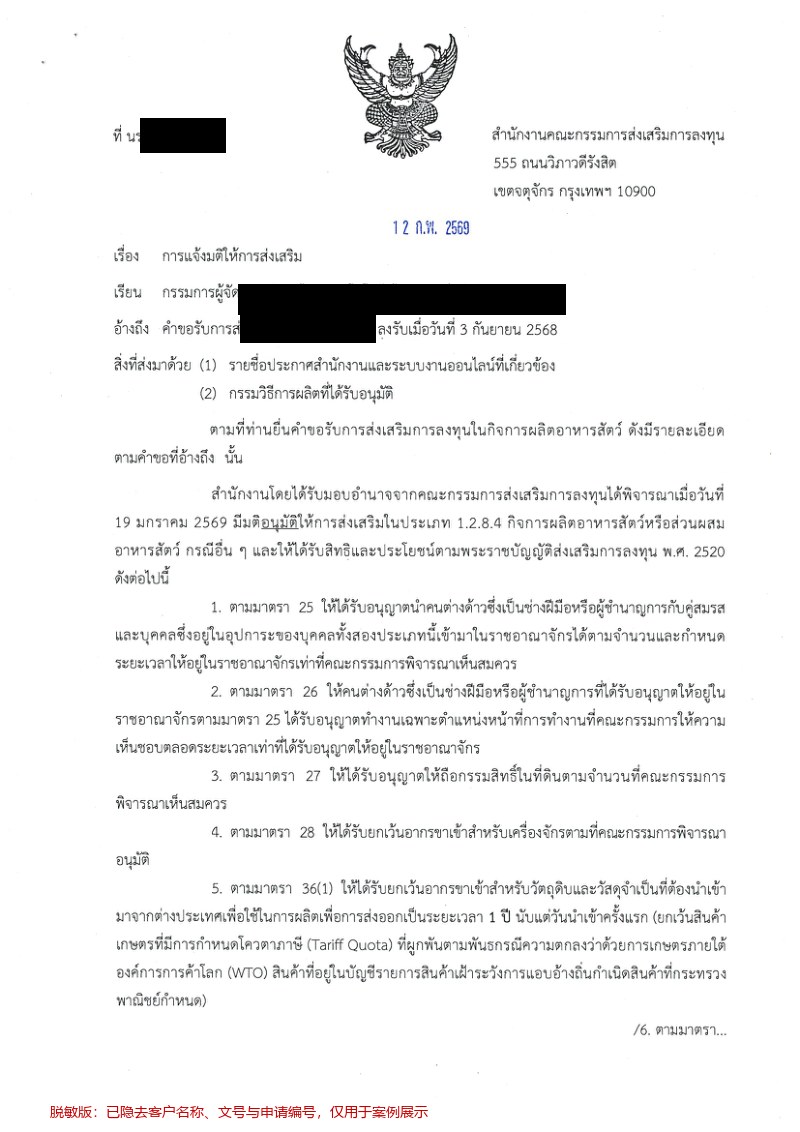
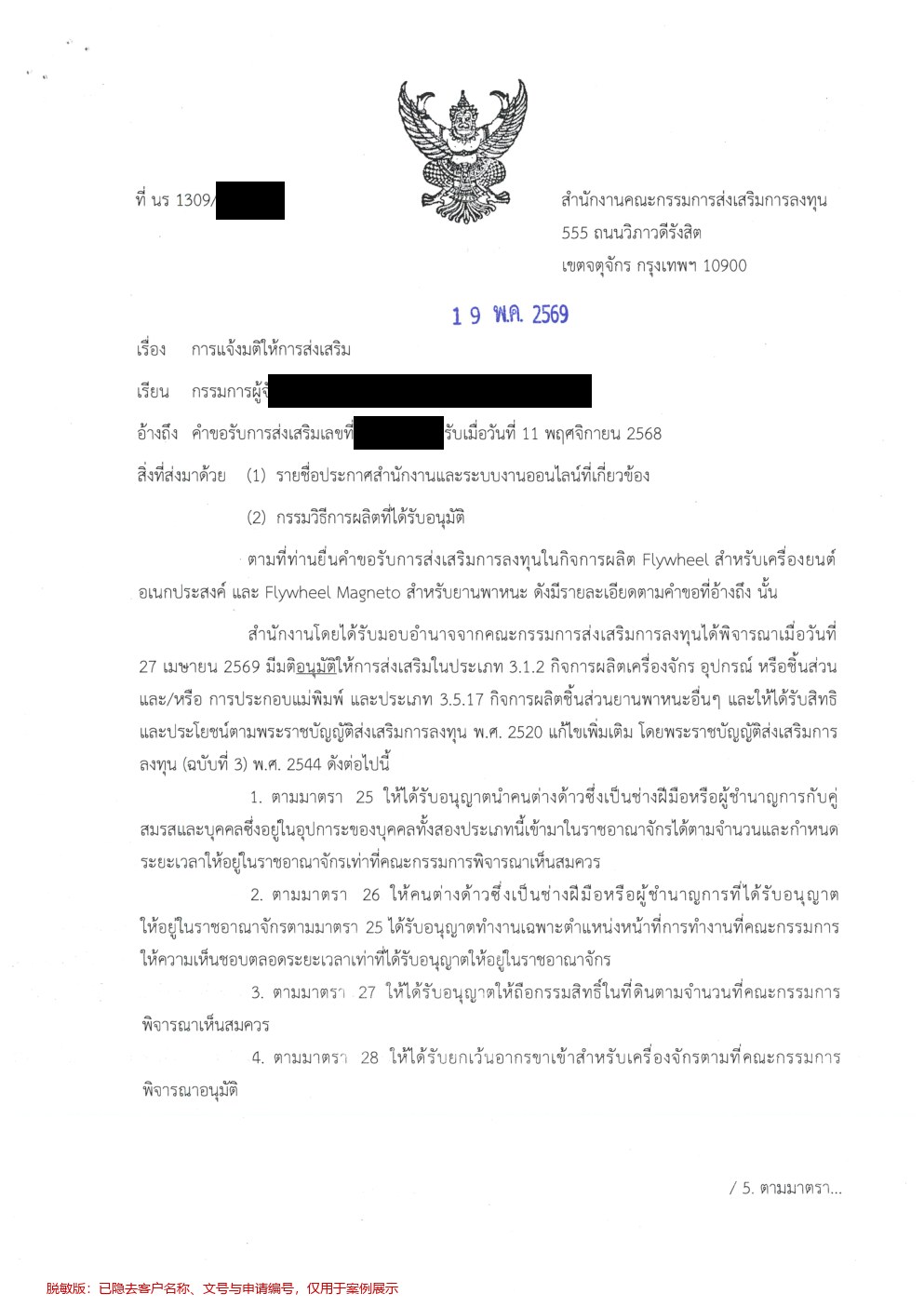
A Chinese power machinery parts manufacturer setting up a factory in Thailand originally applied to the Board of Investment (BOI) under the vehicle parts category, but the review pointed out that the category's corporate income tax incentive could cover vehicle use only. Working from the real uses of the magnetos and flywheel assemblies, Z&X added evidence on production lines, capacity and processes, and secured approval for a plan listing a vehicle category and a machinery category side by side. On April 27, 2026, the project was approved with corporate income tax exemptions of 3 years for magnetos and 5 years for flywheel assemblies, about 5.5 months after acceptance. The professional value lies in clearly identifying the different businesses within one factory, so that products the original category could hardly cover received the incentives that fit them.
BOI approval letter, Thai original, first page (redacted)
2. Background: One factory may involve different promoted activities
After the company's downstream customers expanded into Thailand, they asked it to supply reliably from nearby. The Thai company was incorporated on November 3, 2025, and on November 5, 2025 it engaged Z&X for its BOI application. The magnetos produced at the factory are used mainly in motorcycles and all-terrain vehicles, while the flywheel assemblies are used mainly in equipment such as lawn mowers, small generators and outboard motors. Both products work with engines, but the end machines and uses they serve are different.
3. Problem analysis: The difficulty was turning manufacturing facts into distinguishable activities
Before acceptance, the client wanted to file under generator parts. On November 10, 2025, after reviewing the draft, the BOI reviewing officer asked for it to be changed to Category 3.5.17 (vehicle parts) and for a capacity calculation to be added. The application was accepted on November 11, 2025. After the project presentation meeting on January 14, 2026, the officer raised 12 written questions, which brought the scope of income tax incentives outside vehicle use to the fore.
The 12 questions fell into four groups. First, documents: the presentation slides from the meeting were requested. Second, products: explain the difference between the flywheel assembly and the magneto, whether they are original-equipment or aftermarket parts, and which vehicle models they are used in. Third, manufacturing capability: rewrite the process flow for this specific project and explain the advanced equipment used, key dimensional tolerances and surface roughness. Fourth, scope of incentives: the officer stated clearly that under the vehicle parts category, only flywheels for vehicles could enjoy the income tax exemption, and asked whether capacity for different uses could be separated and whether the product names on the certificate needed to change. The officer also asked why the company had chosen to invest in Thailand.
The fact that the company produces through one company and one factory does not mean all its products belong to the same promoted activity. If the vehicle category continued to cover the whole range, the general-purpose portion risked falling outside the incentives; simply renaming the use, on the other hand, would not match orders and actual production.
| Common misconception | Facts the review needs to check |
|---|
| They are all engine parts, so one category can cover them | Match each model to its end machine, use and customer, then determine the applicable activity for each. |
| More machines means more capacity | Achievable capacity depends on the cycle time of key processes and the number of effective machines; the two product types must be calculated separately. |
| Robots and CNC equipment prove manufacturing capability | Equipment must be tied to specific processes, quality requirements and inspection methods; equipment names alone do not make the case. |
The client knows manufacturing and sales well, but information organised by engineering around drawings, by sales around customers and by finance around the company does not naturally form a single filing explanation. Simply filling in forms, translating and forwarding BOI officers' comments also cannot solve the boundary problem for the client. Z&X needed to organise each department's facts into an activity scope reviewers could check, and keep later materials consistent.
What the officer pointed out was the coverage limit of the original category; the applicable category, manufacturing conditions and document gaps for the remaining business still had to be checked. Only by moving from the scope reminder to a classification argument, recalculated capacity and technical answers did Z&X turn its service into a plan that could be reviewed.
4. Methodology and strategy: The CODE model moved use classification and evidence checks forward together
The approach was first to identify which end machine each product serves and what function it performs, and then map the use and processes in Thailand to the category conditions. Machinery Category 3.1.2 also requires checking conditions such as forming processes for key functional parts or engineering design; "not for vehicles" alone does not establish eligibility 〔1〕. In this case, independent production lines, separable capacity and different customer groups showed that the businesses could be distinguished. These were the evidence in this case, not a general formula for automatically obtaining multi-category approval.
The two activities carry different exemption periods, and the line between uses must remain traceable after approval: which products, revenue and investment records belong to which category has to lead back to the same basis. Clarifying these relationships at the filing stage lays the groundwork for later finance and tax work.
Z&X applied its CODE compliance-growth model to the filing. O (Orchestrated Structure) linked products, uses, processes, equipment and capacity; D (Dual-Track China–Thailand Coordination) had the parent company's engineers confirm the facts, while the team's Thailand-side head prepared the formal answers and liaised with the review; E (Verifiable Delivery) kept the Chinese–English versions, Thai answers and application versions; and C (Compliance Calendar) tracked deadlines for acceptance, supplementary filings and post-approval steps. The difference lay in turning the category direction into a complete set of materials and identifying which data a change in one use would affect.
Z&X proposed adding Category 3.1.2 in its written answers to the 12 questions. The assessment took three steps. First, the team confirmed item by item with the client what the Thai factory's flywheel assemblies are actually fitted to, establishing that they mainly serve small petrol engines in lawn mowers, welding machines, construction equipment, outboard motors and small generators, not vehicles. Second, it checked the agricultural, construction, marine and power machinery scope covered by 3.1.2 and whether the flywheel assembly's forming and machining processes met the conditions. Finally, it separated the flywheel assembly's product name, capacity and customer list from the vehicle category and listed them under the new category, updating the product names for the certificate in the same answer.
5. Plan and implementation: Adding a category meant reworking capacity and technical explanations
Capacity was calibrated before acceptance. The client had originally estimated capacity as "one piece per machine per hour" multiplied by the number of machines. Z&X instead checked it against the bottleneck equipment, the CNC lathes, using this case's working-time assumption of 8 hours a day and 300 days a year, and calculated the two product types separately. The key point is that one product passes through several processes, so the output of all machines cannot simply be added together; the calculation must trace back to unit machining time, the number of effective machines and line arrangements before it can match the equipment list and investment plan.
Right after the presentation meeting, Z&X proposed that the magnetos continue under the vehicle parts category while the flywheel assemblies be filed separately under the machinery parts category, explaining that the two lines are independent, capacity is calculated separately and the customer groups differ. The team checked both lines against actual use, calculated capacity separately and organised the customer destinations. Once the scope was clear, it also had to ensure that specifications, processes, equipment and the application form described the same business, so the new category and old attachments would not contradict each other.
Shared resources were handled on the principle of "separate what can be separated, and do not double-count what cannot". Each product type's capacity was calculated on its own bottleneck CNC lathes, and the main equipment, capacity and customer lists were listed separately in the application. Shared items such as the factory building remained in a single investment plan, and the combined corporate income tax exemption cap for the two activities is 100% of the investment amount (excluding land and working capital); splitting into two categories does not count it twice.
Technical answers were organised around the review questions. The parent company's engineers supplied drawing dimensions, equipment accuracy and customer models; Z&X prepared Chinese–English versions and then converted them into Thai for submission. The two products were compared by material, structure, function and use, and the process flow was completed with steps such as turning, keyway broaching, dynamic balancing, magnetising and performance testing. Dimensional tolerances and taper bore roughness explained the machining requirements, while CNC lathes and in-line inspection explained how they are achieved and controlled, so that the advanced equipment and specific manufacturing activities supported each other.
Key project milestones
| Date | Progress |
|---|
| November 10–11, 2025 | Initial category adjusted and capacity calculation added; application accepted. |
| From January 14, 2026 | Project presentation meeting; 12 questions answered and machinery category filing materials added. |
| April 27, 2026 | Two-activity plan approved. |
| May 19, 2026 | Approval letter issued; certificate conditions followed up. |
6. Results and value: Approval of two activities broadened incentive coverage for the products
| Product use in this case | Approved category | Corporate income tax exemption |
|---|
| Magnetos for vehicle use | 3.5.17 Manufacture of other vehicle parts | 3 years |
| Flywheel assemblies for general machinery | 3.1.2 Manufacture of machinery, equipment and parts | 5 years |
From acceptance on November 11, 2025 to approval on April 27, 2026 took about five and a half months. The added machinery category argument brought the flywheel assemblies within the corresponding incentives, with a longer exemption period. Activities listed side by side on one certificate still need their approved products, tax periods, caps and obligations to be read separately; it cannot be assumed that the whole factory is uniformly exempt or that the same investment cap can be used twice.
7. Conclusion: Cross-border professional services need to connect business facts with rule boundaries
Manufacturers usually organise their business by product family, customer and factory, while the regulatory system sets conditions and incentives by promoted activity. The value of professional services lies in building a verifiable correspondence between the two, and in keeping use identification, technical evidence and later management connected. What the industry can reuse is the method of identifying boundaries, tracing data and coordinating confirmation; specific category combinations still have to be argued case by case. This capability helps companies obtain the incentives that apply and gives post-approval operations a sound basis.
Companies whose products span vehicle and general machinery uses can submit product models, end uses, processes, equipment and capacity information to Z&X and request an assessment of BOI categories and filing routes.
Related: Thailand BOI Investment Promotion Application; BOI Policy Misunderstanding and Incentive Implementation; Company Registration & Approval Services for Chinese Manufacturers in Thailand; Registration & Approvals for EV and Auto Parts Makers
Public references
〔1〕BOI Investment Promotion Guide 2025. General conditions refer to the guide above; project categories and incentives should be verified against the rules in force at the time of application and the approval documents.



 One on one exclusive financial and tax consultation