Thailand BOI Case: Battery Structural Parts Maker Approved About Seven Weeks After Refiling Following a Category Dispute
— From a category dispute to approval about seven weeks after refiling: how Z&X adjusted the route amid differing Chinese and Thai views and kept the project moving
1. Summary: The right change of course came from rebuilding a shared basis for review
A Chinese manufacturer of new-energy battery structural parts set up a factory in Thailand, and its Board of Investment (BOI) application successively drew classification views treating its products as vehicle parts, metal products and electronic parts. Following advice from a BOI office in China, the client twice applied under higher-incentive categories, and neither was accepted. It faced a serious risk of a much longer approval process, or of not being approved at all. The Z&X team helped the client weigh the options and refile under Category 5.4.11.5, reorganising the product scope and process evidence. The new application was accepted on April 17, 2026 and approved on June 8, 2026, about seven weeks later. The professional value of this case lies in turning conflicting views into a plan the client could decide on, the team could carry out and the reviewers could verify and approve.
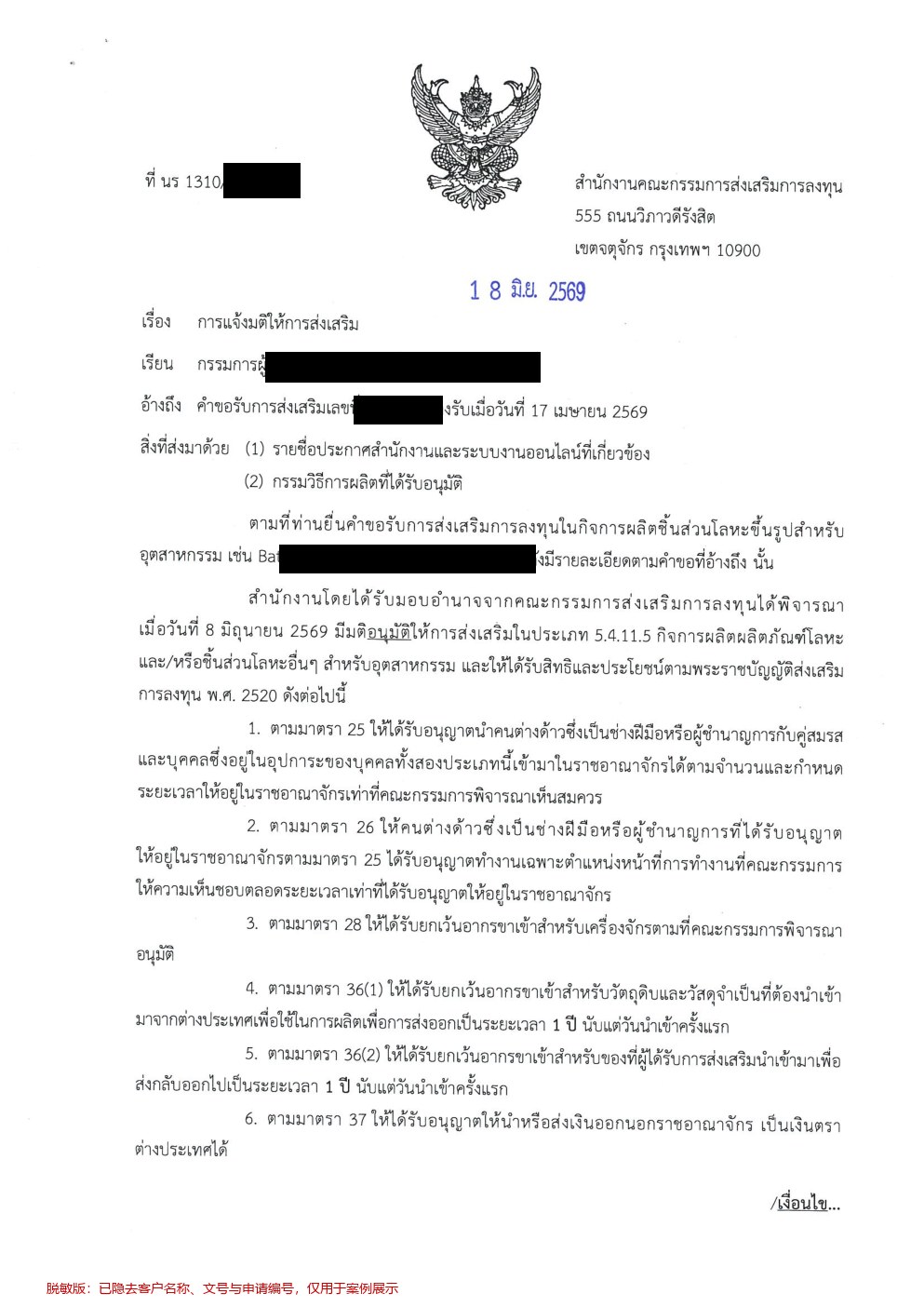
BOI approval letter, Thai original, first page (redacted)
2. Background: Category expectations need to match what the Thai factory actually does
The client is the Thai subsidiary of a Chinese group. It produces structural parts such as aluminium cases and cover plates for new-energy batteries, which can be used in both electric vehicles and energy storage. When Z&X formed the project team on January 13, 2026, the client already had Chinese-language materials and expected to apply quickly for a higher-incentive category. The difficulty was that the group's familiarity with its products did not mean the same product introduction could adequately explain the use, processing depth and filing scope of this particular Thai project.
3. Problem analysis: The dispute tested project boundaries and commercial trade-offs
In early March, a filing under Category 3.5.17 (vehicle parts) was not accepted: this category covers only electric vehicle parts, while the client's aluminium cases and cover plates are used in both electric vehicles and energy storage. The client then wished to apply under Category 5.4.11.4 (metal products and parts for industrial use). The Thailand BOI Guangzhou Office (the BOI's official overseas office in China) considered this feasible, but the new Thai reviewing officer proposed considering Category 4.2.20 (electronic products and parts) instead. Z&X asked the BOI officers to reconsider, attaching the Guangzhou office's view, but the feedback did not change. The Thai reviewing officer then withdrew the original application and asked for it to be refiled under Category 5.4.11.5 (Manufacture of other metal products and/or metal parts for industrial use).
Category 5.4.11.4 was not accepted because of the reviewing officer's view of the products' nature. The officer's written opinion held that the products were not used only in vehicles, and that batteries are electronic products, so the products should not be classified as industrial metal products but should instead be filed under electronic products and parts. Advice from the BOI office in China cannot replace the Thai reviewing officer's determination on a specific project.
| What the dispute appeared to be about | The real issue to resolve |
|---|
| Vehicle parts, energy storage parts or electronic parts? | End use, part characteristics and the promoted activity in this project are not the same thing; the scope of this application has to be made explicit. |
| Why did the office in China say yes while the Thai review did not accept it? | Check the materials, conditions and stage of opinion each side relied on; advisory views cannot replace formal approval of a specific project. |
| Keep the original category or change the route? | Compare whether new evidence could change the assessment, the cost of continued waiting, and the incentives and obligations of the alternative route. |
Arguing over BOI category names was therefore unlikely to resolve the dispute. Public guidance shows that the difference between 5.4.11.4 and 5.4.11.5 involves how processes connect within the same project and the forming requirements, so the two cannot be compared simply by the label "aluminium products" 〔1〕. The team needed to establish which processes the project actually performs in Thailand and how in-house and purchased parts make up the product, and then explain which category these facts support.
Potential risk: continuing to insist on a category that had not been accepted could lengthen the timeline or prevent approval altogether (basis for this judgment: the Thai reviewing officer had already rejected it clearly twice).
Three situations also had to be distinguished: if the wording was unclear, a supplementary explanation would do; if a fact lacked evidence, supporting documents were needed; if an applicable process was genuinely missing, adding the process or changing the route had to be assessed. Group credentials, industry labels or another agency's opinion cannot substitute for project conditions. This distinction determines when to keep pressing and when to stop unproductive back-and-forth.
The client knows the engineering facts but may not be able to judge, at the same time, the weight of evidence, the procedural stage and the cost of a change. Services that simply forward replies and translate materials also leave the burden of judgment with the client. Z&X's difference lies in organising this information into a decision, rather than just passing on a "yes" or "no".
4. Methodology and strategy: The CODE model gave the category change a basis in evidence and execution
Z&X first tried forwarding the differing view to seek reconsideration; only once the alternative route was clear did it organise the refiling. This sequence reflects a sense of proportion: if the original position has room for further evidence, its basis should be explained; when repeated communication brings no new evidence, the obtainable incentives have to be weighed together with the effect of continued dispute on the factory setup schedule. Incentives must also be assessed for actual availability, timing and obligations, while waiting consumes the time buffer for factory setup and imports. A change of course is justified only when the new route fits the real business and the client understands and confirms its costs.
A category change affects product, equipment, capacity and financial assumptions. Changing only the application form while the old attachments may still describe the original use simply does not work. In this case, the specifications and process descriptions for four products were redone to remove inconsistencies. The focus of coordination was to have the right people confirm the same version, reducing time lost to repeated queries.
The Z&X team applied its in-house CODE compliance-growth model. O (Orchestrated Structure) linked the product scope, specifications, processes and share capital documents; D (Dual-Track China–Thailand Coordination) had the team's China-side head explain the trade-offs and organise client confirmation, while the Thailand-side head checked review requirements and handled submission; E (Verifiable Delivery) kept versions, evidence and receipts; and C (Compliance Calendar) connected the deadlines for supplementary filings, acceptance, acceptance of promotion and certificate collection. When materials changed, responsibilities and follow-up arrangements were updated with them, so the change of course did not become another round of waiting from scratch.
5. Plan and implementation: Every adjustment had to produce facts ready for submission
Align on the trade-off first, then reorganise the scope. On March 19, 2026, Z&X discussed the BOI category dispute with the client. After receiving the refiling request, the team prepared the materials again. On April 10, at the reviewing officer's request, it supplied pictures, names and specifications, step-by-step process descriptions and the factory floor plan for four products, defining this application as structural parts for energy storage cells. On April 17, the BOI reviewing officer accepted the application. This adjustment matched real orders, capacity and production plans; limiting the filing to energy storage does not mean the vehicle business automatically receives the same approval.
The basis for the energy storage scope came from the products themselves and where they go: the aluminium case is the housing of the cell, and the cover plate assembly sits on top of the cell, handling electrical conduction and explosion-proof pressure relief. The client's downstream customers assemble the cells into modules and battery packs, and energy storage is one confirmed use. In the supplementary filing, the specification sheets for the four products (two cover plates and two aluminium cases) each stated "for energy storage cells", separating them from the vehicle category that had not been accepted. Vehicle use would be handled through a separate application or project amendment and not mixed into this application.
After the interview, "mainly metal forming" was turned into a verifiable explanation. Following a video interview on May 19, 2026, the officer asked the company to distinguish metal parts from plastic parts and in-house parts from purchased parts, by weight. Z&X prepared a breakdown using the cover plate assembly, showing that metal parts made in-house at the Thai factory accounted for more than 80% of the weight. This broke a complex assembly down into manufacturing activities the reviewer could check and, together with the process evidence, demonstrated where the production focus lay. A weight share is not the same as a local purchasing ratio or value added; it cannot replace category conditions or be generalised into a universal threshold.
Continuity after approval. On June 18, 2026, the BOI issued the approval letter. The team checked the share capital against the financial statements and shareholder registration documents, and from September 16, 2026 helped reissue the bank reference letter and move the certificate collection forward. If vehicle use is added later, the application or amendment route will still need to be checked separately; the energy storage project approval cannot be assumed to apply by default.
Key project milestones
| Date | Progress |
|---|
| March 2026 | Handled the category dispute, discussed it with the client and forwarded the view of the BOI office in China for reconsideration. |
| April 10–17, 2026 | Supplied specifications, processes and the floor plan; refiled under 5.4.11.5 and the application was accepted. |
| May 19, 2026 | After the video interview, supplied explanations of in-house vs. purchased parts and material weights. |
| June 8–18, 2026 | Project approved; the approval letter was then issued. |
| June–September 2026 | Checked share capital, updated the bank reference letter and moved certificate collection forward. |
6. Results and value: Approval in about seven weeks reflected efficient progress after refiling
The project was approved under Category 5.4.11.5. The main incentives include import duty exemptions on machinery and on raw materials for export, and do not include a corporate income tax exemption. The roughly seven weeks run from re-acceptance to approval; from the formation of the project team, the process took about five months. The staged result Z&X delivered was to weigh multiple factors, make the right trade-off, end the back-and-forth over categories, organise the refiling and supplementary evidence, and carry the materials forward after approval. Approval, certificate collection and actual use of the incentives remain separate milestones.
7. Conclusion: Cross-border services should turn disagreement into a reusable capability for execution decisions
Cross-border investment often has to deal with engineering language, regulatory classification and the business clock all at once. Professional services need to turn trade-offs among multiple views into judgments with clear premises, turn experience into verifiable evidence, and connect client decisions with local execution through clear responsibilities. The industry should build reusable mechanisms for questioning, verification and change management, so that pursuing incentives and moving the project forward can be considered together in decisions. Category codes and case handling may differ, but this capability for organised judgment should be reusable over time.
Manufacturers planning a BOI application in Thailand can submit their product uses, processes in Thailand, the original text of any differing opinions and their equipment import plans, and ask Z&X for a category and route assessment.
Related: Thailand BOI Investment Promotion Application; BOI Policy Misunderstanding and Incentive Implementation; Thailand Factory Setup Roadmap: Registration to Production Work Streams; Registration & Approvals for EV and Auto Parts Makers
Public references
〔1〕 BOI Investment Promotion Guide 2026



 One on one exclusive financial and tax consultation