— From application acceptance to approval in under two months: how Z&X used advance preparation and China–Thailand coordination to respond within very short review windows
1. Summary: Speed came from thorough preparation, timely judgment and sound handling
In 2026, a Chinese manufacturer of precision transmission parts set up a factory in eastern Thailand and engaged Z&X Finance and Taxation Group for company registration, VAT registration, trademark filing and its Board of Investment (BOI) application. After the BOI accepted the application on 20 July, the reviewing officer called at short notice to schedule an interview. After the interview, the application was returned with eight questions and a request for a translated supplementary explanation. A pre-committee review on product classification followed. Building on project materials aligned in advance, Z&X coordinated translation, client confirmation and on-the-ground communication. On 8 September, the project was approved by the BOI project review sub-committee under Category 3.1.5.2 (manufacture of high-precision machinery, equipment and parts), with an 8-year corporate income tax exemption. The professional value of this case lies in rapidly turning unexpected BOI requests into specific tasks that could be assessed, assigned and submitted.
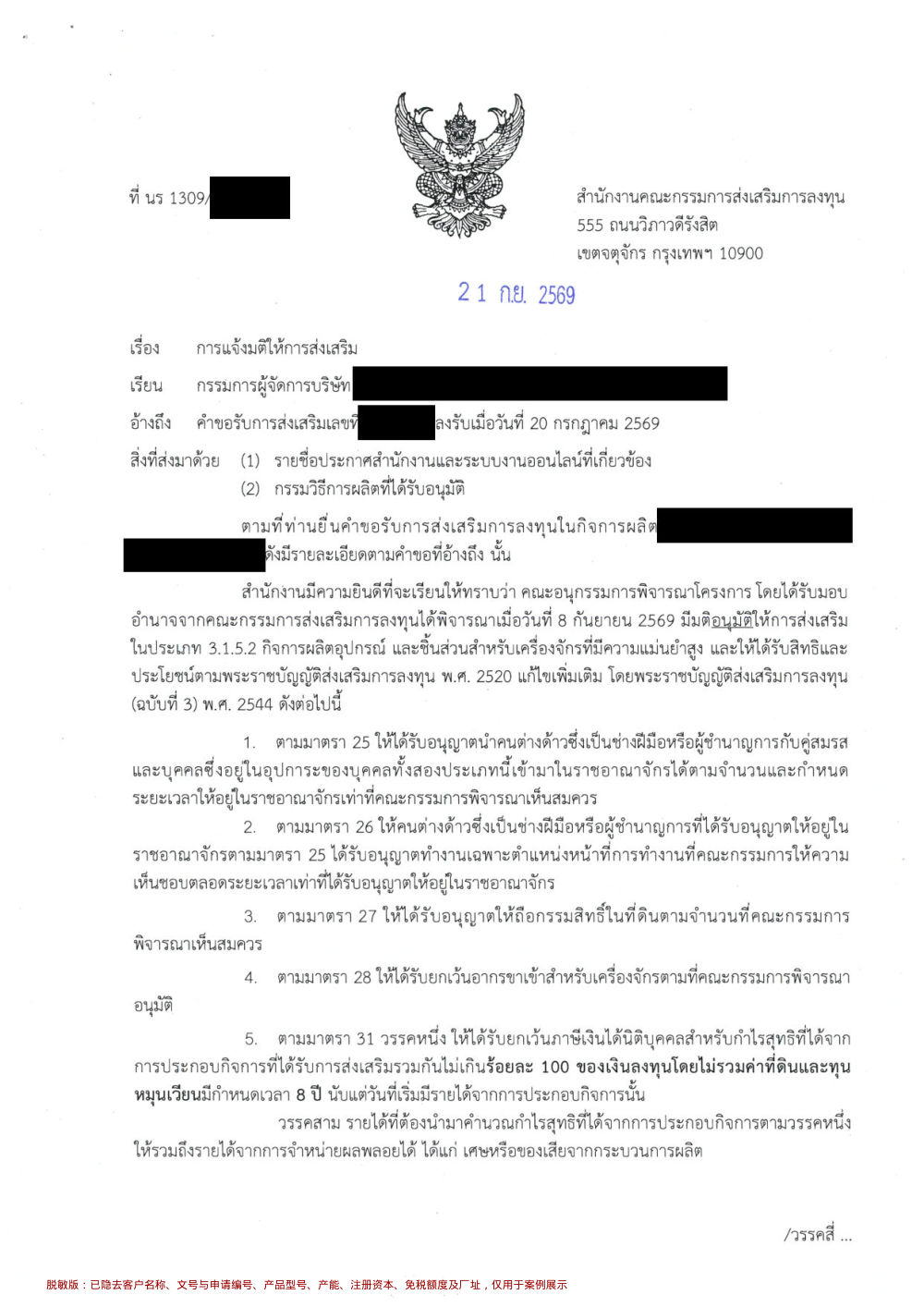
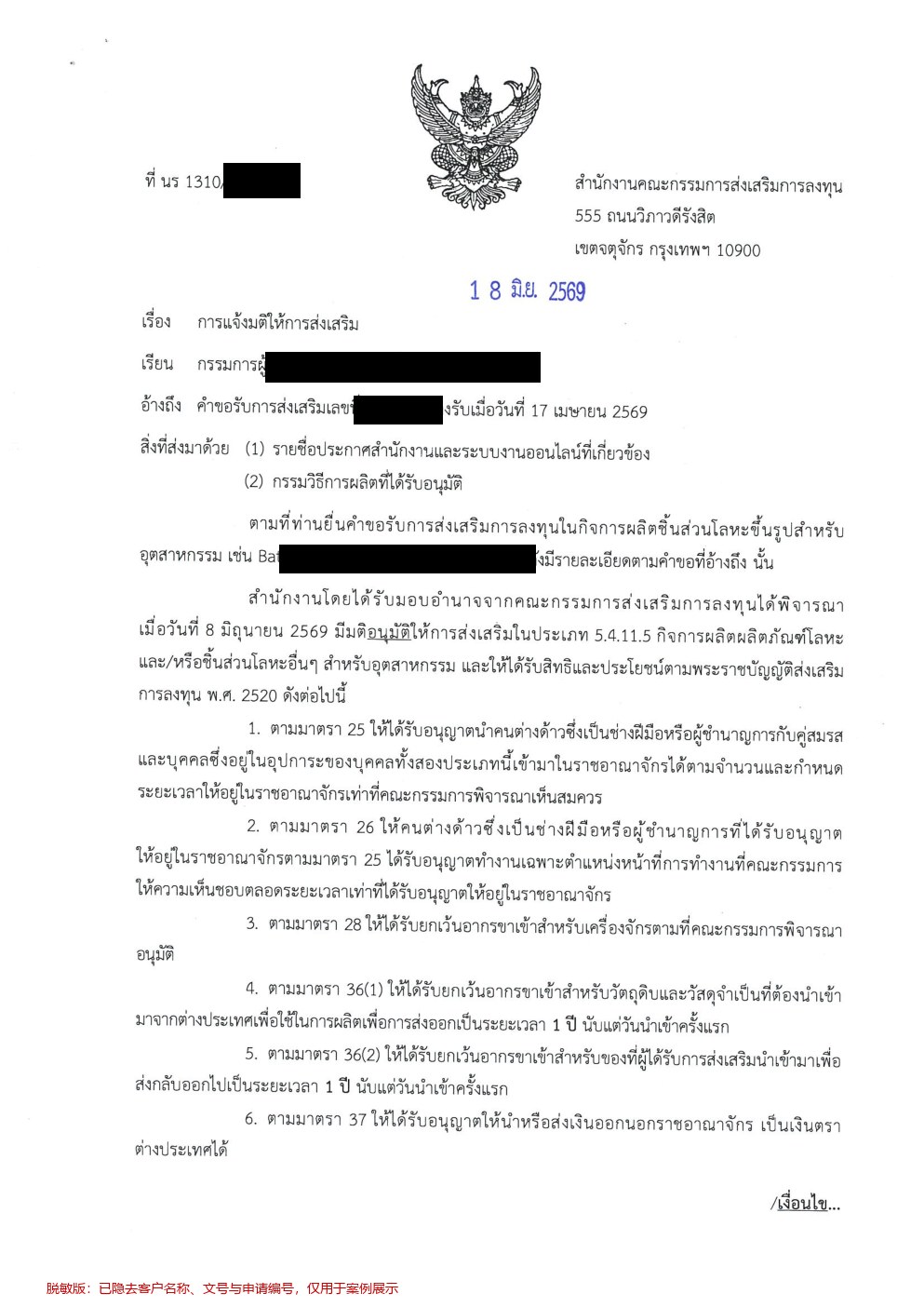
BOI approval letter, Thai original, first page (redacted)
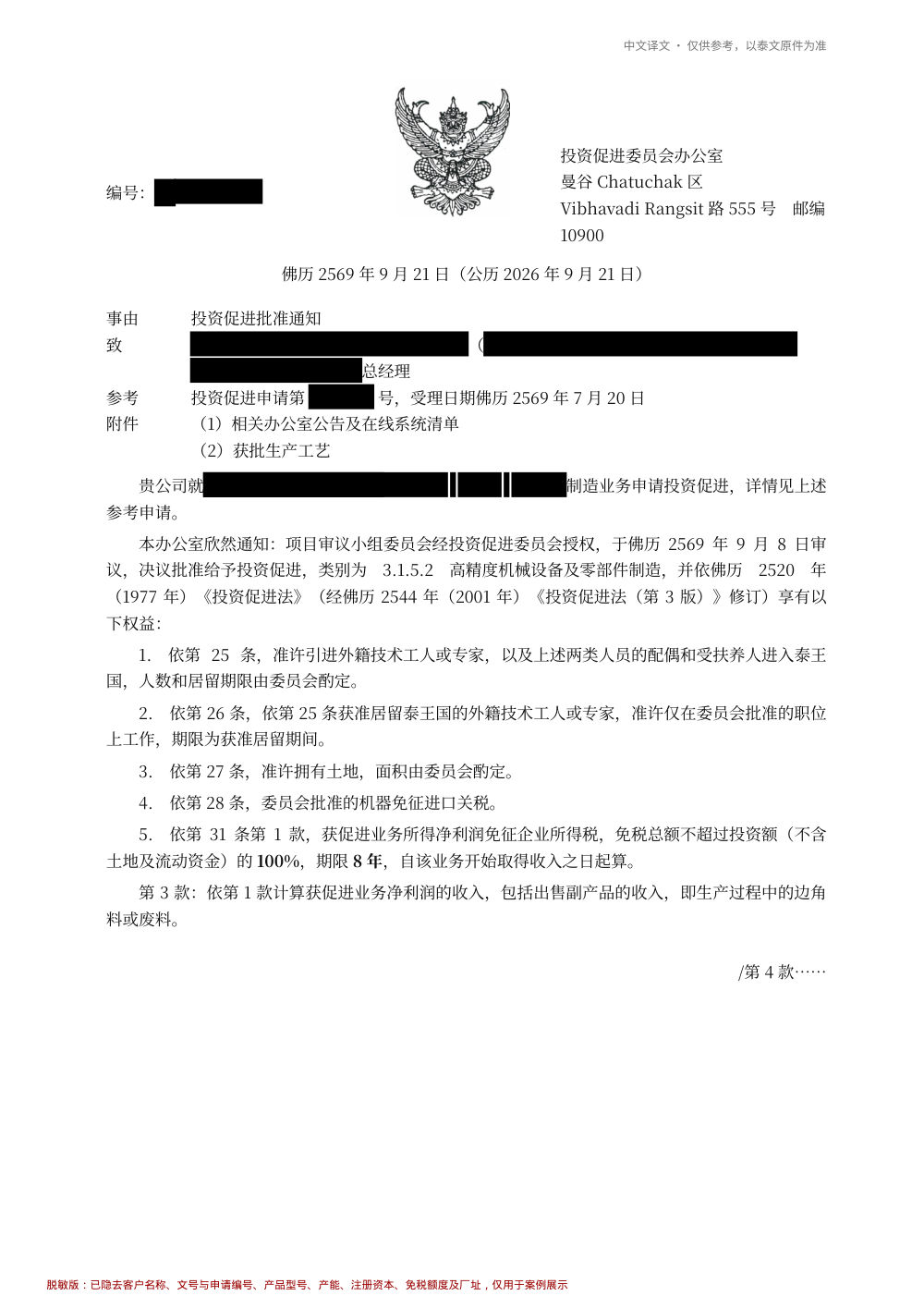
BOI approval letter, Chinese translation, first page (redacted)
2. Background: Several procedures serving a single production goal
The client is a subsidiary set up in Thailand by a Chinese group. It produces high-precision transmission parts and was building a precision manufacturing plant in eastern Thailand. It wanted to move the BOI application forward quickly to prepare for equipment imports and future operations. Z&X had already handled its company and VAT registration and was coordinating its trademark filing. On 25 June, Z&X formed a BOI project team, led overall by the team's China-side head, with the Thailand BOI lead handling the filing and communication with officials.
The engagement required the team to understand both the production plan and the administrative procedures. The interview, supplementary filings, address change and factory permit were interlinked: if any document or decision was delayed, the next step could be affected.
3. Problem analysis: Short-notice requests test decision readiness and the link between evidence and claims
On 21 July, the BOI reviewing officer called to schedule an interview, which was set for 31 July. The BOI website recommends that people familiar with production, finance and marketing attend [2]. Within ten days, the parent company background, project plan, product processes and precision requirements had to be organised into a single presentation package, and the client's relevant staff had to attend and explain the project accurately. Agency scheduling, translation and client preparation each run on their own timelines but had to come together on the same day; the short notice concentrated this multi-track coordination pressure.
The return after the interview moved the questions to the data level. The officer returned the application in the BOI system with eight questions at once and asked for a supplementary explanation with a Thai or English translation. The questions looked scattered, but each concerned data the review report would need.
| Questions raised by the BOI officer | What the review was looking for |
|---|
| Only 3 raw materials were listed; list all raw materials | Depth of local production, which the review report must describe |
| What bearings are used? Provide images and specifications | The line between purchased and in-house parts |
| Is the investment amount final? Large investments go to a sub-committee, which is slower and harder | Whether the investment is genuine and worth a longer process |
| Foreign employees should be at supervisor or expert level or above | Whether foreign positions are necessary |
| Local raw material content should be at least 30% | Contribution to local industry |
| Value added is too high; consider 55%–60% | Whether the figures are reasonable |
| List administrative and selling expenses; separate R&D and other costs | Whether the cost structure is genuine |
The bigger challenge was product classification. On 2 September, the BOI officer asked whether the products had a standard code, whether they were made to order, and whether they qualified as high-precision. These questions required clarifying product identity, production organisation and technical capability separately, and then showing how each supported the application category. A code, an order book or the word "precision" cannot on its own substitute for an eligibility argument.
Answering "made to order" also meant explaining which drawings and technical requirements production follows, which products the orders cover, and whether these match the scope of the application. Only then does high-precision capability have something concrete to be checked against. Breaking the questions down this way lets the materials supplied by technical staff map directly to the points under review.
The client knows manufacturing well, but may not be able to map engineering facts precisely onto review criteria. Materials from technical, purchasing and finance teams do not automatically form a consistent explanation. Services that merely forward questions and translate the text hand the burden of judgment back to the client. This is where service providers differ: whether they can identify the intent behind a question, spot gaps in the evidence and get the right people to confirm in time. That takes familiarity with BOI practice and how officers work, and a China–Thailand team able to handle multiple tasks in parallel with agility.
4. Methodology: Building rapid response on advance coordination with the CODE model
The CODE model is Z&X's in-house methodology for supporting compliant business growth. O (Orchestrated Structure) links the different procedures and project materials; C (Compliance Calendar) tracks the interview, supplementary filing and review milestones; D (Dual-Track China–Thailand Coordination) defines who explains the technology, who contacts the client and who liaises with officials; and E (Verifiable Delivery) keeps confirmed versions, translations and submission records. Rapid response thus rests on a foundation of materials and clear responsibilities.
Technical judgment in particular must be grounded in the rules. For Category 3.1.5.2, the BOI Investment Promotion Guide 2026 specifies recognised forming or assembly processes and sets eligibility paths such as key functional parts of high-precision machinery, or main production equipment capable of machining to tolerance grade IT5 or finer [1]. This means "high precision" has to be explained through concrete evidence of product use or machining capability.
Drawing tolerances reflect product requirements, equipment parameters demonstrate machining capability, and inspection records prove actual results; none can replace the others. The application followed exactly this path. Taking one core reducer component as an example, key dimensional tolerances reached international tolerance grade IT5 (ISO 286) and gear accuracy reached DIN grade 5 (DIN 3962) [3], with measured inspection data better than the standards required. The positioning and repeatability accuracy of the CNC equipment showed it could consistently achieve this precision. For cutting, turning, milling, grinding and drilling, the application also explained which core part reaches what precision at which step, so that the manufacturing flow genuinely supported the category assessment.
Advance review should also separate the engineering facts the client must confirm from the review-ready presentation the adviser prepares, and make clear who has authority to confirm key figures. Then, when a short-notice request arrives, attention can go to people, dates and new questions, rather than restarting a cross-department check from scratch. This kind of professional work organises technical knowledge scattered across the client into a project description that everyone can verify. Z&X's value lies in closely linking engineering facts, application criteria and China–Thailand communication.
5. Implementation: Every round of action addressed a specific review question
Interview preparation began before the formal notice. On 15–16 July, the team had already collected the parent company profile, product images and translations of the three application forms, and aligned the application materials in a voice call between the China and Thailand teams. After the call on 21 July, the interview date of the 31st was confirmed with the client the same day. Before the interview, Z&X and the client prepared a presentation package covering the parent company and shareholder background, overall project plan, product structure and production processes, and precision grades explained against international tolerance standards. The interview was completed on 31 July. The earlier alignment made it possible to coordinate the interview quickly. The officer's eight follow-up questions focused on raw materials, investment, staffing and cost structure, indicating that the products and processes had been made clear at the interview and the review had moved on to the data.
Answering the eight questions one by one, revising where appropriate and explaining where not. The professional threshold in handling a returned application is to identify whether each question concerns missing information, unclear wording or unreasonable data, and then check whether a change affects other documents. Z&X submitted two revised versions of the application forms with a bilingual Chinese–Thai supplementary explanation on 3 and 5 August:
- Raw materials: the castings, forgings and steel bar used for the three core components were listed truthfully, without padding the list, with a note on raw materials that future customer projects might add;
- Bearings: structure, precision grade and specification images were added, explaining their role in the transmission;
- Investment: declared according to genuine equipment needs, explaining that every machine is essential to the project, without lowering the amount to get a faster process;
- Foreign positions were changed to supervisor and expert level, and local raw material content was raised to over 30%;
- Value added was kept at the original figure, with an explanation: in high-precision machining, raw materials are a small share of cost, and the main costs are equipment, highly skilled staff and electricity, unlike general manufacturing;
- R&D expenses were merged into selling expenses, and other costs were broken down into consumables, packaging, cutting tools and fixtures, oils and greases, and administrative expenses.
Organising the pre-committee answers around the classification logic. When the questions came on 2 September, the team asked the client for technical explanations and organised the response: technical staff confirmed product use and the basis for precision, the application team checked the category criteria, and a consistent answer was then prepared. "Standard code" was answered with the ISO 286 and DIN 3962 grades relied on; "high-precision" was answered with three types of evidence: drawing tolerances, inspection records and equipment accuracy; and "made to order" was explained through the project's market arrangements: all products are exported to downstream robot manufacturers, and production scope matches the products in the application. Existing materials could be reused, but the category assessment was rechecked against the new questions. Six days later, the project was approved.
The address matter was built into the overall plan. On 1 and 10 September, Z&X confirmed twice with the client that the registered address change would be made after the approval letter was issued, to avoid changing information during review. The value here lies in identifying how a change affects related procedures and setting the right order; such an arrangement must rest on a truthful application and the requirements applicable at the time.
Key project milestones
| Date | Progress |
|---|
| 25 June 2026 | Thai company incorporated; BOI project team formed the same day |
| 15–16 July 2026 | Parent company profile and product images collected; three application forms translated; China and Thailand teams aligned materials |
| 20 July 2026 | BOI accepted the application |
| 21 July 2026 | Officer called to schedule an interview; interview on the 31st confirmed with the client the same day |
| 31 July 2026 | Interview (project presentation) completed |
| 3–5 August 2026 | Application returned with eight questions; two revised versions of the forms and a bilingual Chinese–Thai supplementary explanation submitted |
| 2 September 2026 | Pre-committee questions answered: standard code, made to order, high-precision classification |
| 8 September 2026 | Approved by the project review sub-committee |
| 21 September 2026 | BOI issued the approval letter, collected by Z&X under power of attorney |
6. Results and value: Closely linked milestones delivered a staged result
The project was approved under Category 3.1.5.2 (manufacture of high-precision machinery, equipment and parts). The main incentives stated in the approval letter include: an 8-year corporate income tax exemption, capped at the investment amount (excluding land and working capital); import duty exemption on approved machinery; import duty exemption for 1 year on raw materials used in exported products; permission to bring in foreign technicians and experts; and permission to own land needed for the business.
Approval came less than two months after the application was accepted. Although the officer had noted that a large investment would mean a slower process, the project was declared at its genuine investment amount and approved on schedule. Z&X's value centred on organising the interview promptly, answering the eight questions within two days, and answering the pre-committee questions according to the classification logic. Each step was closely linked to the next, and no stage was postponed because of a slow response. This case measures results by milestone progress and staged approvals; the client supplied the facts and confirmed them, and the BOI made the final determination.
7. Conclusion: Manufacturers going abroad need to turn expert judgment into a lasting capability
The complexity of cross-border manufacturing investment comes from the need to link engineering facts, administrative determinations and construction schedules. Whether someone understands technology, translates well or knows the process, that knowledge has to become project capability through shared materials, clear responsibilities and confirmation mechanisms.
The transferable lesson of this case is to move preparation ahead of the application and let each round of feedback update the facts, evidence and plan. For data questions from officers, understand the review concern behind them; respond to unreasonable suggestions with the industry's cost structure, and do not change figures just to pass review. For classification questions such as "is it high-precision", provide evidence through drawing tolerances, inspection records and equipment accuracy parameters. When choosing a service provider, companies should look at how it explains questions, organises verification and handles related changes together. Similar projects can reuse this method, but interview dates, translation arrangements and the order of address changes must be decided case by case.
Chinese companies planning to build a factory in Thailand can share their product processes, planned site, target production date and current registration and BOI progress, and ask Z&X for a category assessment or a registration-to-production work plan, to clarify the key judgments, document gaps and overall schedule.
Related: Thailand BOI Investment Promotion Application Services; Thailand Company Registration & BOI Approval Services for Chinese Manufacturers; Thailand Factory Setup Roadmap: Registration to Production Work Streams; Registration & Approvals for EV and Auto Parts Makers
Public references
[1] BOI Investment Promotion Guide 2026
[2] BOI website FAQ: application guidance and project approval
[3] ISO 286 (dimensional tolerance grades); DIN 3962 (gear accuracy grades)



 One on one exclusive financial and tax consultation