Thailand Tightens Nominee Enforcement: Nominee Arrangements Proposed as a Predicate Offence Under the Anti-Money Laundering Act
Thailand's regulation of nominee shareholders (นอมินี, i.e. people holding shares on someone else's behalf) is shifting from “administrative enforcement” towards “criminal and asset-based” measures. According to a report dated 19 September 2026, the Ministry of Commerce is pushing to amend the law so that nominee violations become a predicate offence under the Anti-Money Laundering Act. If enacted, related assets could be seized and frozen before a judgment is handed down. At the same time, cracking down on nominee arrangements has been listed as one of the Ministry of Commerce's nine urgent tasks.
1. Current Penalties and the Proposed New Tool
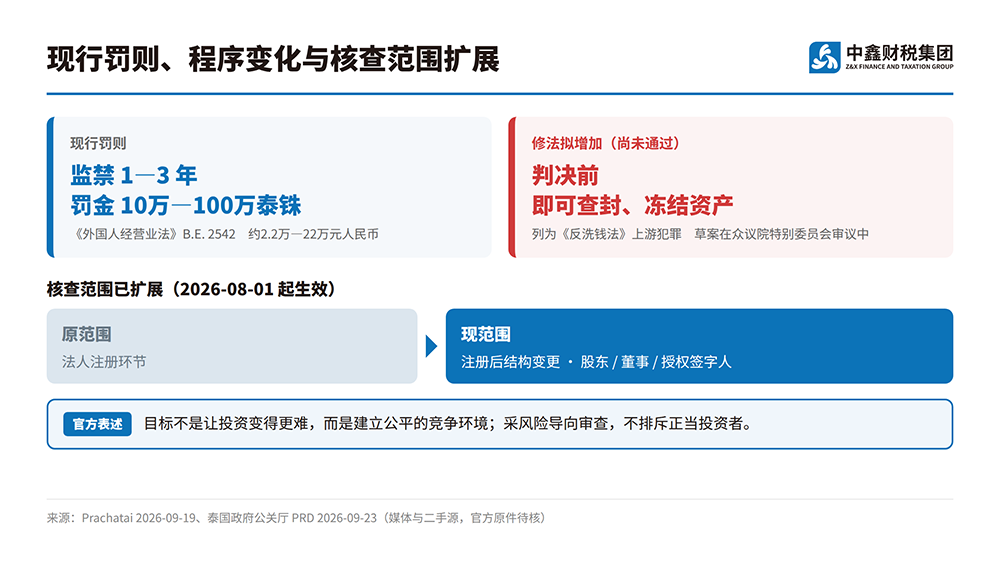
The current legal basis is the Foreign Business Act B.E. 2542 (พระราชบัญญัติการประกอบธุรกิจของคนต่างด้าว พ.ศ. 2542). The penalties for nominee violations are imprisonment of 1 to 3 years and a fine of THB 100,000 to 1,000,000 (about RMB 22,000 to 220,000).
The proposed new tool is to make nominee violations a predicate offence under the Anti-Money Laundering Act (ความผิดมูลฐานฟอกเงิน). The practical consequence of this classification lies not in the size of the fine but in procedure: once a case enters the anti-money laundering framework, assets can be seized and frozen before the case is decided. For companies, this changes how fast the risk hits. The impact no longer comes only after losing in court; accounts and assets may be affected as soon as a case is opened.
According to the report, the draft is currently under review by a special committee of the House of Representatives. It has not been passed and is not yet in force.
2. How Penalties Were Allocated in Two Decided Cases
The two cases disclosed in the report show how penalties are actually distributed in practice.
The accounting firm case:
Defendant 1: fined THB 1,000,000
Defendant 2: 60 months' imprisonment and a fine of THB 1,000,000
Defendants 3 to 12 (10 nominee companies): fined THB 100,000 each and ordered to cease operations
The Phuket case: there were 23 defendants in total, about 9 to 10 of them foreign nationals, and all were convicted.
The structure of the accounting firm case deserves the attention of Chinese-invested companies in Thailand: it was not only the companies using nominees that were punished. The service provider that arranged the nominee structures was also in the dock, and it received the heaviest sentence (60 months' imprisonment). Nominee arrangements have never been a case of “at worst, a small fine if you get caught”.
3. Verification at Registration Has Already Tightened
According to the Department of Business Development's briefing to the House economic development committee: since 1 January 2026 (B.E. 2569), when a Thai–foreign joint venture with less than 50% foreign shareholding applies for registration, its Thai shareholders must provide three months of bank statements showing where the share capital came from. From 1 August 2026 the measure was upgraded to also cover incorporations and amendments that appoint foreign directors, which must submit financial evidence for both the Thai shareholders and the foreign directors. As a result, registration applications from the high-risk group (joint ventures with less than 50% foreign shareholding) fell to 141 between 1 and 20 August 2026, compared with 561 in the same period last year, a drop of 75%.
A report by the Government Public Relations Department (PRD) on 23 September 2026 added details on the enforcement mechanism:
Since 15 September 2026, cracking down on illegal businesses and illegal goods has been one of the Ministry of Commerce's “nine short- and medium-term urgent tasks”;
On 29 April 2026, 23 agencies signed a memorandum of understanding to integrate information sharing and enforcement;
Since 1 August 2024, the Department of Business Development (DBD) has operated the e-Foreign Business system, through which foreign investors can submit licence applications online;
From 1 August 2026, the scope of checks has expanded from the company registration stage to post-registration structural changes, including changes of shareholders, directors and authorised signatories.
This last point is the most substantive change in this round of regulation. In the past, compliance review focused on “the moment of registration”; it now extends across the company's entire life after registration. Even if the shareholding structure was clean at registration, later changes made without a proper assessment will also come under scrutiny.
4. The Official Balancing Statement Must Be Read Alongside
The PRD report quotes the Minister as stating clearly that “the goal is not to make investment more difficult, but to create a fair competitive environment” for operators who do business lawfully and transparently. The report also explains that reviews are risk-based and do not exclude legitimate investors.
This is not mere diplomatic language. It means the tightening targets arrangements whose structure is itself unlawful, not foreign investors as such. For companies holding valid licences with genuine shareholding structures, stronger verification actually works in their favour.
Key Takeaways
The Ministry of Commerce is pushing an amendment to make nominee violations a predicate offence under the Anti-Money Laundering Act, allowing assets to be seized and frozen before judgment. The draft is under review by a special committee of the House of Representatives and has not been passed or taken effect.
Current penalties under the Foreign Business Act (B.E. 2542): 1–3 years' imprisonment and a fine of THB 100,000–1,000,000.
Accounting firm case: the main defendant received 60 months' imprisonment and a THB 1,000,000 fine, and 10 nominee companies were each fined THB 100,000 and ordered to cease operations. The service provider that arranged the nominee structures was convicted too.
From 2026-08-01, checks have expanded from the registration stage to post-registration changes of shareholders, directors and authorised signatories.
23 agencies signed a memorandum of understanding on 2026-04-29; DBD's e-Foreign Business system has been live since 2024-08-01.
The government has stated clearly that “the goal is not to make investment more difficult, but to create a fair competitive environment”; reviews are risk-based and do not exclude legitimate investors.
Z&X Tip
If your company's current Thai shareholding structure includes individual shareholders whose role cannot be clearly explained, or if the articles of association do not match the actual control relationships, now is the time to act, not to wait and see. Because checks now extend to post-registration changes, being discovered costs more than fixing the issue proactively. We recommend three steps: first, verify the facts of the shareholding structure and the articles of association; next, determine whether the business falls under the restricted lists of the Foreign Business Act and whether it needs a Foreign Business Licence (FBL) or can use the BOI or treaty route; and only then file the change registration. Z&X's Company Registration and Licensing Services cover DBD company registration, drafting of articles of association, verification of registered capital, and applications for special licences such as the FBL. The application of the law must be assessed case by case and is subject to the determination of the competent authorities.
Sources
เผยกำลังมีการแก้ กม. ให้ “นอมินี” เป็นความผิดมูลฐานฟอกเงิน เพิ่มอำนาจยึด-อายัดทรัพย์ | Prachatai (media report, not an official original document) | 2026-09-19 | https://prachatai.com/journal/2026/09/118812
ประเทศไทยเพิ่มมาตรการต่อต้านนอมินี | Government Public Relations Department, PRD (กรมประชาสัมพันธ์) | 2026-09-23 | https://www.prd.go.th/th/content/category/detail/id/33/iid/544086



 One on one exclusive financial and tax consultation