Heavy Penalties for Illegal Employment: Employers Face Fines of Up to THB 100,000 per Worker, and THB 200,000 for Repeat Offences
Overview
On 4 September, the Thai government issued a nationwide warning through a deputy government spokesperson, prohibiting employers from hiring foreigners who do not hold work permits, or from allowing permit-holding foreigners to do work beyond the scope of their permits. The announcement also set out the full penalties and this fiscal year's enforcement figures: so far, more than 74,000 workplaces have been inspected nationwide, and more than 1,700 foreign workers have been found doing jobs reserved for Thai nationals. For Chinese-invested factories and service businesses in Thailand that employ foreign workers, this is an announcement that must go onto the self-inspection checklist.
1. The Two Types of Violation Named
The government announcement clearly separates violations into two types, and both are punishable:
The first is “employment without a permit”: hiring a foreigner who does not hold a work permit (ใบอนุญาตทำงาน).
The second is “employment beyond permit scope”: the foreigner holds a work permit but does work beyond what the permit authorises. In practice this type is more easily overlooked. If the position, employer or work location stated on the work permit does not match reality, the case falls into this category.
The announcement also named four occupations that Thai law reserves for Thai nationals, flagging them as high-risk areas: Thai massage (งานนวดไทย), hairdressing (งานตัดผม), beauty services (งานเสริมสวย) and driving vehicles (งานขับขี่ยานพาหนะ). Of these, “driving vehicles” matters most in practice for manufacturing and logistics companies. Who drives the forklifts inside the factory, the staff shuttle buses and the delivery vehicles is a question inspectors will ask directly.
2. Penalties: Both Employers and Workers Are Punished
The legal basis is the Emergency Decree on Managing the Work of Foreigners B.E. 2560 (พระราชกำหนดการบริหารจัดการการทำงานของคนต่างด้าว พ.ศ. 2560). The penalties listed in the announcement are as follows.
Employers
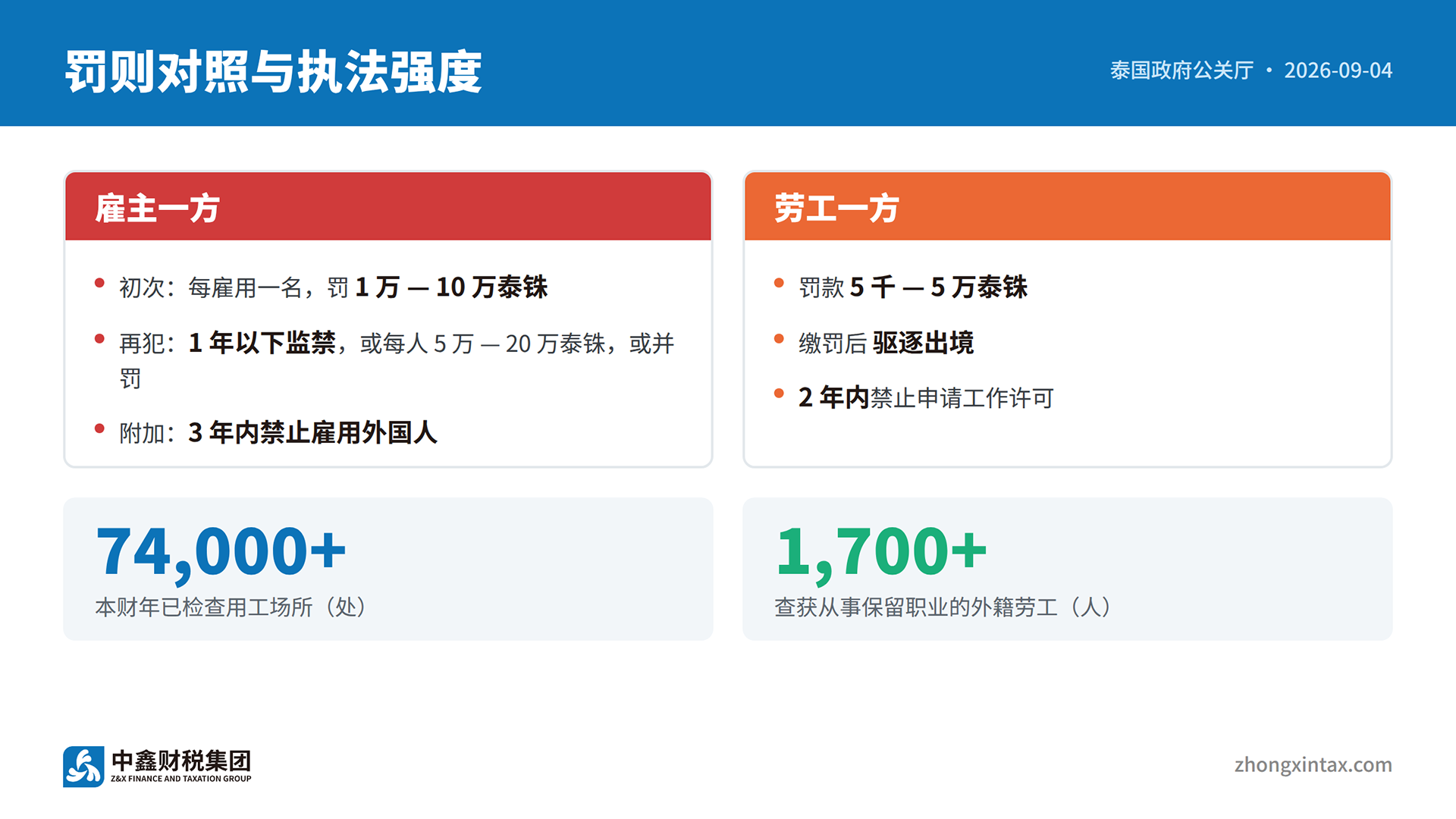
First offence: a fine of THB 10,000–100,000 (about RMB 2,200–22,000) for each foreigner employed in violation
Repeat offence: imprisonment of up to 1 year, or a fine of THB 50,000–200,000 (about RMB 11,000–44,000) per person, or both
In addition: a ban on employing foreigners for 3 years
Workers
A fine of THB 5,000–50,000 (about RMB 1,100–11,000)
Deportation after paying the fine
A ban on applying for a work permit for 2 years
For employers, the real force of these penalties lies in the “per person” calculation and the additional consequence of the “3-year ban on hiring foreigners”. If a factory with a sizeable workforce is found to have several workers employed illegally, the fines add up per head. And for manufacturers that rely on workers from Myanmar, Laos and Cambodia, being unable to hire any foreigner for 3 years is almost equivalent to the risk of a production shutdown.
3. Enforcement Intensity: 74,000 Sites Inspected This Fiscal Year
The announcement also published enforcement figures for fiscal year B.E. 2569 (FY2026) to date:
More than 74,000 business premises employing foreign workers inspected nationwide
More than 1,700 foreign workers found doing jobs reserved for Thai nationals
This is not a one-off campaign. One week earlier, Ministry of Labour records also showed that the Nakhon Phanom Provincial Labour Office took part in a joint inspection on 28 August under the “Project for Managing Illegal Migrant Foreign Workers”. Joint inspections in border provinces are continuing during this period.
(Infographic: penalties compared and enforcement intensity)
Key Takeaways
Employment without a permit and employment beyond permit scope are punished alike; the position, employer and work location on the work permit must match reality.
Four occupations were named: Thai massage, hairdressing, beauty services and driving vehicles. “Driving vehicles” directly covers factory forklifts and on-site vehicles.
Employer fines are calculated per head: THB 10,000–100,000 per person for a first offence; a repeat offence can bring up to 1 year's imprisonment and a 3-year ban on hiring foreigners.
Workers face fines of THB 5,000–50,000, deportation after payment, and a 2-year ban on applying for a work permit.
This fiscal year, more than 74,000 workplaces have been inspected and more than 1,700 foreign workers found in violation.
Z&X Tip
The risk in employment compliance often lies not in “whether a permit has been obtained”, but in “whether what is written on the permit matches what the person actually does”. Changes of position, internal transfers and support work at other factory sites can all amount to employment beyond permit scope without anyone realising. In day-to-day operations, the employee payroll and personal income tax management within Z&X's Accounting and Tax Outsourcing service, and the social security account registration within our Company Registration and Licensing Services, include cross-checking the employee roster against what is declared. We recommend that companies compare work permits with actual positions once a quarter, and list separately for review roles that “do not look like positions”, such as forklift, shuttle bus and delivery drivers. Whether a particular case constitutes a violation is subject to the determination of the competent authorities.
Sources
Original title: รัฐบาลเตือนนายจ้างทั่วประเทศ ห้ามจ้าง-ใช้บริการ “แรงงานต่างด้าว” ทำงานผิดกฎหมาย ชี้โทษหนักทั้งคนจ้างและแรงงาน
Agency: Government Public Relations Department, Thailand (กรมประชาสัมพันธ์, PRD)
Date: 2026-09-04 (4 September B.E. 2569)
URL: https://www.prd.go.th/th/content/category/detail/id/33/iid/538443
Supplementary source (joint inspection): สำนักงานแรงงานจังหวัดนครพนม ร่วมตรวจบูรณาการตามโครงการบริหารจัดการผู้หลบหนีเข้าเมืองกลุ่มแรงงานต่างด้าว | Ministry of Labour, Thailand (กระทรวงแรงงาน) | 2026-08-28 | https://www.mol.go.th/news



 One on one exclusive financial and tax consultation