2026 Compliance Self-Check for Chinese Companies in Thailand: 10 Checks to Find Your Risk Zone
In the second half of 2026, Thailand's supervision of foreign-invested companies underwent a change that is easy to miss but has a big impact: it moved from "complaint-driven plus spot checks" to "data screening first".
Regulators no longer verify companies one by one. Instead, they use registration data to flag high-risk entities in bulk and then inspect them on the ground. This means practices that relied on "not being noticed" are quickly losing their effectiveness.
This article does not interpret policy; it is a self-check tool. The 10 checks cover 5 dimensions, and most of them can be done without outside help, using documents your company already has. When you finish, you will know which risk zone you are in and what to deal with first.
1. Why Now: Three Changes That Have Already Happened
Change 1: Shareholding structures are being scanned in bulk
On 11 September 2026, Thailand's Government Public Relations Department (PRD) reported interim results of its crackdown on nominee shareholding: new registrations of "high-risk" companies with 0.01%–49.99% foreign shareholding fell from 894 in August B.E. 2568 to 163 in August B.E. 2569, a year-on-year drop of 81.77%.
This was accompanied by a large-scale review of existing companies. According to figures published by the Department of Business Development (DBD) on 7 September 2026, with data as of 4 September B.E. 2569: 144,706 juristic persons were analyzed, 125,622 of them within the DBD's supervisory scope; 123,542 juristic persons hold 1,269,326 land plots totaling 4,504,926.88 rai; of these, 31,516 land-holding juristic persons have 0.01%–49% foreign shareholding; and another 14,878 juristic persons hold 244,115 condominium units.
On the enforcement side, a special operation on Koh Phangan in Surat Thani found 112 juristic persons whose foreign shareholding exceeded the legal limit, involving 124 land plots, of which 104 were newly discovered and pending investigation and 8 already had court rulings.
One point must be made clear: the 0.01%–49.99% shareholding range is a screening criterion, not a finding of illegality. Many legitimate Chinese-Thai joint ventures fall within this range precisely because the Foreign Business Act requires it. Whether nominee shareholding exists must be determined through case-by-case investigation and by the competent authorities.
But one thing is certain: the threshold for new incorporations has risen, while existing companies remain in the database. The review covers existing companies.
Change 2: The window for staying in Thailand has narrowed
Under a Ministry of Interior announcement (published in the Royal Gazette on 31 August 2026), from 15 September 2026 the previous 60-day visa exemption ended and was replaced by a tiered system: 60 countries and territories receive 30 days, 2 countries (Seychelles and Mauritius) receive 15 days, and 3 countries including Azerbaijan are newly eligible for visa on arrival. Arrangements based on bilateral agreements remain in force, granting 90, 30 or 14 days depending on the agreement.
Another rule has a more practical impact on companies: visa-exempt entry through land border checkpoints is limited to two times per calendar year (except for Malaysia, Brunei, Indonesia and Singapore).
The real significance of this adjustment is not the length of stay. Visa-exempt entry gives you the legal status of a visitor, not a worker; working in Thailand requires a work permit, regardless of how long you stay. The previous 60-day window was wide enough to mask many "long-term business trip" staffing arrangements; now that the window has narrowed, what was masked will be the first to surface.
Change 3: BOI privileges are no longer "once and for all"
A BOI press release on 11 September 2026 disclosed a case that every promoted company should note: a steel company had its BOI incentives suspended for violating the Factory Act and industrial product standards. Its eligibility was restored only after the Ministry of Industry verified that the issues had been rectified, retroactive to 5 June 2026. The BOI stated that it will continue joint supervision with the Ministry of Industry.
Note the structure of this case: the violation that triggered the suspension was not within the BOI system. It was a Factory Act and industrial product standards issue, not a missing BOI report. Yet the consequences fell directly on the BOI privileges.
At the same meeting, the BOI also approved a shift in investment promotion direction, from "investment volume" to "real investment and value creation", focusing on five priorities: higher added value, supply chain linkages, high-skilled employment, R&D investment and technology transfer.
Incentives are an ongoing status, not a one-time grant.
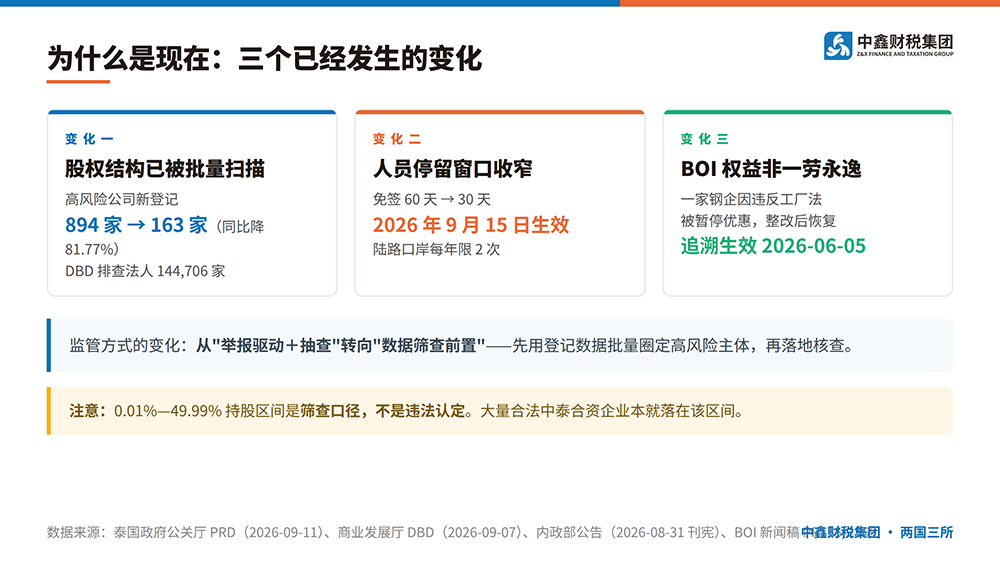
The three changes
2. The 10 Self-Checks
How to use: for each item, compare your situation with the "criteria" and give yourself one of these marks:
OK: documents are complete and would stand up to inspection
Unclear: the situation is genuine but documents are incomplete, or you are not sure yourself
Act: clearly does not comply
Count the number of "Act" and "Unclear" items; Section 3 shows the corresponding risk zone.
Dimension A: Shareholding Structure (3 items)
A1. Which range does total foreign shareholding fall into?
What to check: Open the company's registration documents and add up the shareholding of all foreign parties (including the Chinese parent company, Chinese individuals and other foreign entities).
Criteria:
Total holding between 0.01% and 49.99%: you are within the scope of the current screening; continue to the following checks.
100% foreign-owned and holding an FBL or BOI promotion: OK
100% foreign-owned without the corresponding license: Act
Falling within 0.01%–49.99% is not a problem in itself; it only means a higher chance of being inspected. The real assessment lies in A2 and A3.
A2. Capital contribution evidence and source of funds of Thai shareholders
What to check: Obtain the bank statements showing the Thai shareholders' actual capital contributions, along with an explanation of the source of funds at the time (salary, business income, family assets, etc.), and check that they match the shareholder register and proof of contribution.
Criteria:
Complete contribution records, with a source of funds consistent with their income and assets: OK
Bank records exist but the explanation of the source is incomplete: Unclear
The contribution was transferred from the foreign party's account, or returned to the foreign party shortly after being paid in: Act
This is the most central item in determining nominee shareholding. If a Thai national earning THB 30,000 a month holds 51% of a company with THB 20 million in registered capital, where did the money come from? That question must have an answer.
A3. Are there any unregistered agreements between shareholders?
What to check: Go through all documents from the company's incorporation, including those never submitted to the DBD.
Criteria:
No such agreements exist: OK
There are clauses such as "Thai shareholders do not participate in dividends", "shares may be transferred at par to a designated party at any time" or "all voting rights are delegated": Act
Once discovered, such clauses are essentially written evidence of nominee shareholding. Note: even if the agreement has never been used, its mere existence is the problem.
Dimension B: Registered Address and Business Substance (2 items)
B1. Is the registered address a genuine place of business?
What to check: Confirm on site how the registered address is actually being used.
Criteria:
A genuine office or production site, or an office address under a lawful lease: OK
The address is real but nobody works there and government letters cannot be received: Unclear
On site it is a residence or vacant property, or a large number of unrelated companies are registered at the same address: Act
In the current enforcement campaign, false addresses and nominee shareholding are often dealt with in the same case. The address is the easiest item to cross-check in data screening.
B2. Ownership structure of the entity holding real estate
What to check: If the company holds land, factory buildings or condominium units, separately check the shareholding structure of the entity that holds them (it may not be the same company).
Criteria:
The holding entity is 100% Thai-owned, or its foreign shareholding complies with legal limits: OK
The holding entity's foreign shareholding falls in the high-risk range, and A2/A3 are marked Unclear or Act: Act
The core focus of the current DBD review is precisely "juristic persons holding real estate". The reason is easy to understand: direct foreign ownership of Thai land is strictly restricted, holding it indirectly through a company is a workaround, and land registration data is readily available for bulk comparison.
Dimension C: Staff and Employment (2 items)
C1. Are your people in Thailand "visitors" or "workers"?
What to check: Divide everyone in Thailand into two groups based on what they actually do, not on the nominal number of business-trip days.
Criteria:
Short visits (inspections, negotiations, trade fairs): visitors; visa exemption or a business visa is compliant.
Substantive work (production, management, technical support, resident sales): workers; a work permit is required regardless of length of stay.
Marking rules:
All people doing substantive work hold valid work permits: OK
There are borderline cases (short-term technical guidance, equipment installation and commissioning): Unclear
Some people do substantive work on visa exemption or a tourist visa: Act
A commonly confused concept: a visa is not a work permit. A visa determines whether you can enter and how long you can stay; a work permit determines whether you can work here. Holding a work visa does not mean you can start work directly; you also need to obtain a work permit.
C2. Do the details on work permits match reality?
What to check: For each person, check whether the employer name, position and place of work on the work permit match their actual situation.
Criteria:
Fully consistent and within the validity period: OK
The job description differs from the actual work: Unclear
The employer or place of work does not match reality: Act
This is the item most often overlooked in practice. Companies assume that once the permit is issued, everything is fine; but a permit that does not match reality is, in nature, the same kind of problem as having no permit at all.
Dimension D: Accounts and Invoices (2 items)
D1. Are the accounts in step with actual operations?
What to check: Pull up the most recent month's accounting records and look at how far invoice entry has progressed and when the reports were produced.
Criteria:
Monthly closing is completed within 5 working days, and invoices are entered in the same month: OK
Closing takes more than 10 days, or invoices are backlogged by more than a month: Unclear
Some invoices have gone unrecorded across quarters, or the reports are clearly out of line with actual operations: Act
Several real industry scenarios recorded on our website can serve as a reference: a home appliance manufacturer had not entered its January–September invoices into the system, overstating profit by 30%; a machinery exporter took 15 days each month to close its books (versus only 3 days in China), leaving financial data seriously delayed.
D2. Can differences between the Chinese and Thai financial statements be explained?
What to check: Put the Thai entity's local financial statements side by side with the statements consolidated into the group, and see whether each difference can be explained item by item.
Criteria:
Each difference corresponds to a difference in accounting standards, with a written explanation: OK
Differences exist but have not been systematically reconciled: Unclear
Differences are large and cannot be explained, or the auditor has issued a qualified opinion on them: Act
Reference scenario: the Thai side of a new energy company provided only Thai-language tax returns each month; the differences between the Chinese and Thai statements reached several million baht, the auditor refused to issue an unqualified opinion, and the company's financing was blocked as a result.
Dimension E: BOI Compliance (1 item, only for approved companies)
E1. Status of BOI privileges
What to check: Do not look only at the BOI reports; carry out a cross-departmental review:
| Item | Status |
|---|
| Is the BOI/IC system account working normally? | |
| Are the machinery and raw material list filings complete? | |
| Are raw material reconciliation calculations completed on time? | |
| Are half-year progress reports submitted on time? | |
| Are annual comprehensive reports submitted on time? | |
| Any outstanding matters with the Ministry of Industry (Factory Act, industrial product standards)? | |
| Any outstanding matters with labor or environmental authorities? | |
Criteria:
The steel company case above illustrates exactly this point: the cause of a violation may lie outside the BOI system, but the consequences fall directly on BOI privileges.
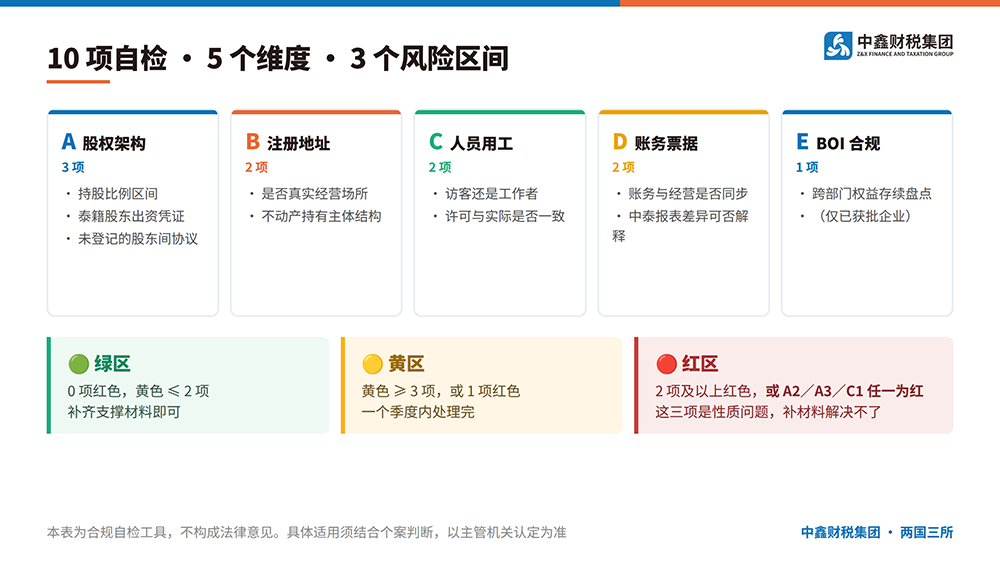
Self-check matrix
3. How to Read Your Results
| Zone | Criteria | Recommendation |
|---|
| Green zone | 0 Act items, 2 or fewer Unclear items | The structure is basically healthy. Compile the supporting documents for the Unclear items into a file; do not wait until you are asked for them. |
| Yellow zone | 0 Act items and 3 or more Unclear items; or 1 Act item | There are clear improvement items, but they are not urgent. We recommend dealing with them within one quarter, in the order Act first, then Unclear. |
| Red zone | 2 or more Act items, or any one of A2 / A3 / C1 marked Act | We recommend a professional assessment as soon as possible. A2, A3 and C1 are issues of substance, not paperwork, and delay will not make them better. |
Why A2, A3 and C1 are singled out: these three items correspond to the genuineness of capital contributions, side agreements and employment status. What they have in common is that they cannot be fixed by adding documents, only by changing the actual arrangements. The earlier an Act item is found, the more options are available.
4. What Are the Options Once You Find a Problem?
Shareholding structure (A1–A3 marked Act)
There are three main compliant routes:
Apply for a Foreign Business License (FBL): operate legally as a foreign entity within the approved business scope, without a 51% Thai shareholding.
Apply for BOI investment promotion: projects in promoted categories may be allowed foreign majority ownership while also enjoying tax incentives.
Restructure as a genuine joint venture: bring in a Thai partner who genuinely contributes capital and genuinely takes part in operations.
Which route to take depends on whether the industry falls within the restricted lists annexed to the Foreign Business Act, the scale of investment, and whether the company meets the application requirements.
Registered address (B1 marked Act)
Two things must be handled at the same time: changing to a genuine, lawful registered address, and making sure that address can properly receive government letters with someone to sign for them. Changing the address without solving the receipt problem is the same as not changing it at all.
Staff and employment (C1–C2 marked Act)
Bring everyone doing substantive work into the work visa and work permit system. This has prerequisites: the company needs the corresponding hiring qualifications (registered capital, ratio of Thai employees, etc.), so it often has to be planned together with the shareholding structure.
Accounts and BOI (D or E marked Act)
Accounting issues are relatively straightforward to handle; the core is back-filling entries and rebuilding the books. For BOI issues, first identify which authority the violation relates to, then deal with each one separately.
The applicability of the above routes must be judged case by case and is subject to the determination of the competent authorities.
5. Real Cases
Published results
An electronics company: full rebuild of the books. At handover there was only a box of disorganized invoices. Within 15 days the full books for January–October were rebuilt, revealing THB 820,000 of VAT underreported by the previous agent, which was remedied in time to avoid tax penalties.
A manufacturing company: system migration. The company switched from local Thai software to Z&X's international system, cutting reconciliation time from 5 days a month to under half a day, and headquarters can now view the Thai subsidiary's financial data in real time.
6. Related Z&X Services
Company Registration and Approval Services: Going global starts with compliance. Services include company establishment (company registration with the DBD, drafting articles of association, registered capital verification), tax registration (VAT number application on form PP.01, social security account registration), bank account opening, special licenses (Foreign Business License (FBL), factory license applications), intellectual property, address services (lawful registered addresses in Bangkok, Chonburi and elsewhere), and changes and deregistration. Relevant to Dimensions A and B of this article.
Full-Cycle BOI Compliance Services: BOI approval is only the beginning; long-term compliance is what matters. Services include systems and filings (opening BOI/IC system accounts, machinery and raw material list filings), import and logistics, production and reconciliation (raw material reconciliation calculations and reports), periodic reporting (preparing and submitting half-year progress reports and annual comprehensive reports), visa services (full support for BOI visas), and managed services. Relevant to Dimensions C and E of this article.
Accounting and Tax Agency: An accounting and tax agency is a "plug-and-play" compliance engine for a business. Typical services include monthly bookkeeping and tax filing, annual financial statements, payroll and personal income tax management, VAT refund applications, and tax registration and changes. We use the international editions of Kingdee and Yonyou, with operation and output in Chinese, English and Thai. Relevant to Dimension D of this article.
7. How Z&X Handles These Projects
The difficulty in compliance remediation usually lies not in knowing what to do, but in explaining things clearly to the authorities. Z&X's approach addresses two long-standing pain points in the industry:
First, local agents respond slowly and struggle to understand what Chinese companies actually need, leading to repeated document revisions and long approval times. At Z&X, a Chinese project manager leads the whole process and understands Chinese business models in depth, while the Thai team follows up locally; working together on both tracks shortens processing time by 30% on average.
Second, language and cultural differences raise communication costs, making it hard to communicate with government departments and causing documents to be returned frequently. Z&X uses a bilingual Chinese-Thai team that understands Chinese culture and knows Thai procedures. In remediation projects, what needs to be explained to the authorities is often not "what document is missing" but "what this company's business logic is", and that requires understanding both sides.
This is backed by a "rapid response" standard: a reply within 15 minutes in the WeChat group, and a proposal within 1 hour for urgent matters. Explanation notices from the authorities usually come with a clear response deadline, so response speed directly affects the outcome.
The Z&X team has 15 years of service experience and entered the Thai market in 2023, and has since served 300+ Chinese-invested companies in Thailand and taken part in 100+ BOI projects.
8. Final Word
In this self-check, the three items in Dimension A, the first item in Dimension B and the two items in Dimension C (six items in total) can all be completed today using your company's existing documents, without any outside help.
Start with these six. Once you have done them, you will know where you stand, and that is more useful than knowing what has changed in policy.
This article is a compliance self-check tool and does not constitute legal advice. Specific application must be judged case by case and is subject to the determination of the competent authorities.
Free download: Compliance Self-Check for Chinese-Invested Companies in Thailand (PDF, 3 pages): 13 checks across six areas, ready to print and tick off.



 One on one exclusive financial and tax consultation